After more than two decades immersed in Knowledge Management across military, government, consulting, and corporate environments, I have learned one consistent truth: Knowledge Management is not a buzzword, and it is not a software deployment.

Knowledge Management is a strategic discipline that helps organizations learn faster than their environment changes. It strengthens decision making, reduces preventable rework, improves mission and operational performance, and protects hard won expertise from walking out the door.

If you want a simple definition that works in the real world:

Knowledge Management is the deliberate way an organization creates, curates, shares, applies, and improves what it knows, so people can make better decisions and deliver better outcomes.

That is the difference between “we store information” and “we operate with organizational intelligence.”


The 5 Pillars of Knowledge Management

Over time, I have seen countless frameworks and maturity models. Most work when they are grounded in execution. In practice, KM stands on five pillars that must reinforce each other.

1. People

KM starts and ends with people.

Tools do not share knowledge. People do. The highest performing environments make it easy and safe for people to:

  • Ask questions without penalty
  • Share lessons without blame
  • Teach others without losing status
  • Challenge assumptions with respect
  • Build networks of trust across teams

When KM succeeds, it is because people are supported, recognized, and equipped to do knowledge work as part of normal work.

Practitioner signal: If knowledge sharing depends on heroic volunteers, it will not scale. Make it part of the job, the rhythm, and the incentives.


2. Process

Sustainable KM is built on repeatable processes that fit the operational cadence.

KM processes are not extra work. They are how you reduce waste and improve performance. Examples that consistently produce results:

  • After Action Reviews and Retrospectives that lead to updates in guidance, training, and standards
  • Peer Assists before major work to reuse what already works
  • Communities of Practice that solve problems and standardize good practice
  • Structured onboarding and proficiency pathways that reduce time to competency
  • Knowledge capture for critical roles, not as “interviews,” but as operational handovers

Practitioner signal: If you capture lessons but do not change how work is done, you have reporting, not learning.


3. Organizational Culture

Culture is the true engine of KM.

Where culture encourages openness and learning, KM thrives. Where culture rewards hoarding, KM becomes a checkbox. The cultural ingredients I see in strong KM organizations include:

  • Trust and psychological safety
  • Leaders who ask, “What did we learn?” and “What did we reuse?”
  • A norm that knowledge is an organizational asset, not personal property
  • A bias toward evidence, transparency, and continuous improvement

Culture is not posters and slogans. Culture is what happens when deadlines hit and things go wrong.

Practitioner signal: Watch what gets rewarded. If speed is rewarded but learning is punished, KM will always be fragile.


4. Tools and Technology

“Technology is an enabler, not the solution”.

Platforms like SharePoint, ServiceNow, Confluence, and enterprise search can be powerful. Yet without the other pillars, they become expensive filing cabinets.

In strong KM programs, tools are designed to make knowledge:

  • Findable: you can locate the best answer quickly
  • Usable: the content is written for action, not archives
  • Trusted: authoritative sources are clear, current, and governed
  • Embedded: knowledge appears in the workflow where decisions are made

If users must hunt across multiple systems, KM adoption will collapse under real work pressure.

Practitioner signal: Users do not want “more information.” They want the best answer, with confidence, at the moment of need.


5. Governance

Governance is the backbone that makes KM durable.

Governance is not bureaucracy. It is clarity. Good governance answers:

  • Who owns this knowledge domain
  • What is authoritative versus optional
  • How quality is reviewed and kept current
  • How access, privacy, and security are handled
  • How standards, taxonomy, and metadata are applied
  • How KM aligns to mission, strategy, and measurable outcomes

Without governance, KM becomes a collection of well meaning efforts that drift, duplicate, and decay.

Practitioner signal: If no one is accountable for knowledge quality and currency, your AI, analytics, and decisions will inherit that risk.
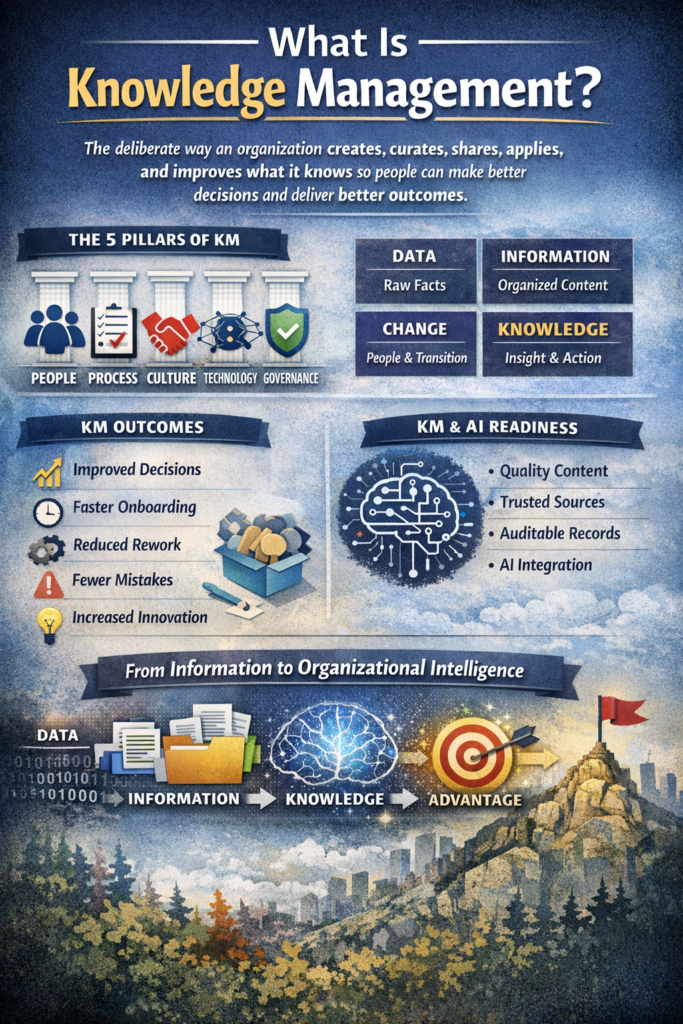
What is KM Infographic

KM Versus Information, Data, and Change Management

A lot of organizations struggle because they blur these disciplines. Each is essential, but they are not the same.

  • Data Management: Manages raw data, definitions, lineage, quality, and stewardship.
  • Information Management: Organizes documents, records, content, and retrieval.
  • Change Management: Prepares people to adopt new ways of working and sustain behavior change.
  • Knowledge Management: Integrates people, process, culture, technology, and governance so information and experience become actionable insight and improved performance.

A practical way to think about it:

Data becomes information when it is organized and contextualized.
Information becomes knowledge when it is interpreted, shared, and applied.
Knowledge becomes advantage when it drives better decisions and outcomes.

Example: SharePoint and ServiceNow can support information management very well. The KM value appears when you add learning processes, communities, validated knowledge assets, and governance that keep content accurate, discoverable, and operationally relevant.


The KM Outcomes Leaders Actually Care About

KM is not measured by the number of documents uploaded or pages viewed. Those are activity metrics, not outcome metrics.

KM creates value when it improves results such as:

  • Faster onboarding and reduced time to proficiency
  • Fewer repeat incidents and fewer preventable failures
  • Increased reuse of proven practices and reduced rework
  • Better decision quality through traceable rationale and evidence
  • Greater resilience during turnover, reorgs, or surge operations
  • Increased innovation by connecting expertise across silos

If you cannot connect KM to operational outcomes, the program will always be vulnerable at budget time.


KM in the Age of AI

AI has raised the stakes.

If your knowledge is ungoverned, outdated, duplicative, or difficult to trace back to authoritative sources, AI will amplify that problem. Many organizations are learning that AI readiness is less about the model and more about the knowledge foundation.

In practice, modern KM must support:

  • Source grounded answers and citations to authoritative knowledge
  • Clear ownership and lifecycle management
  • Content quality controls and review rhythms
  • Taxonomy and metadata that improve retrieval precision
  • Decision records and rationale that support auditability

AI does not replace KM. AI makes KM non negotiable.


Closing Thought

KM is not a one time initiative or a plug and play solution. It is a capability that grows with practice, leadership commitment, and disciplined execution.

If your organization is ready to move beyond storing information and toward building real organizational intelligence, I would welcome the conversation.

Question for you: Which pillar is the strongest in your organization today, and which one is the biggest constraint?


“Don’t Buy the Tool Before You Know the Terrain: Why Every Organization Needs a Knowledge Assessment First”

In today’s digital rush, organizations often jump head-first into implementing new technologies. AI systems, data lakes, collaboration platforms, or analytics dashboards, with CEO, CTO, and other C-Sutie officials believing that the right tool will automatically solve their knowledge problems. However, this approach can be likened to buying expensive gym equipment without ever assessing your fitness goals, capabilities, or habits.

A recent client’s feedback captured this mindset succinctly:

“I was disappointed by the absence of technological integration in the proposal…”

This sentiment reveals a common misconception that technology is strategy. Technology is only an enabler, not the foundation of effective Knowledge Management (KM).

What a Knowledge Assessment Actually Does

A Knowledge Assessment is a structured evaluation of how an organization creates, shares, stores, and applies knowledge to achieve its objectives. It identifies critical enablers and barriers across four domains: People, Processes, Technology, and Culture.

Without this diagnostic phase, even the most advanced technology investments risk failing because they do not align with how knowledge flows within the organization. ISO 30401 (the international KM standard) emphasizes this alignment as the first step in building a sustainable KM system (ISO, 2018).

Why Organizations Skip It

Organizations often skip the assessment stage for three reasons:

  1. Perceived urgency: leadership wants quick wins.
  2. Vendor influence: solution providers market platforms as “plug-and-play.”
  3. Budget optics: assessments are seen as overhead, not as value creation.

The irony is that skipping the assessment usually costs far more in the long run. Research by Davenport and Prusak (1998) shows that up to 70% of knowledge initiatives fail when technology precedes strategy or assessment. Similarly, McKinsey (2020) found that firms that perform up-front knowledge audits see three times higher adoption rates for digital platforms.

Lessons from the Field

At Knoco, we have observed that organizations that neglect knowledge assessments often face predictable outcomes:

  • Misaligned technology that doesn’t fit business workflows.
  • Poor adoption because staff don’t see value.
  • Data duplication, versioning issues, and knowledge silos.
  • Reimplementation costs when the platform fails to deliver.

The client quoted earlier, for example, prioritized technology over knowledge diagnostics. Six months later, their project stalled due to low engagement and unclear ownership. Symptoms that a proper Knowledge Assessment would have revealed early.

The Hidden ROI of a Knowledge Assessment

A Knowledge Assessment is not a cost; it’s a risk-mitigation investment.
Its outcomes provide:

  • A baseline for measuring maturity and readiness.
  • A blueprint for aligning KM strategy to business goals.
  • A gap analysis identifying where people, processes, and technology must evolve.
  • A change management roadmap that ensures adoption, not just installation.

Organizations that conduct these assessments typically reduce technology rework costs by 30–50% (Gartner, 2022) and experience higher user engagement within the first 90 days post-implementation.

Technology Should Follow Knowledge

The Knowledge Assessment informs us what technology is truly needed, not what looks modern or impressive. For instance:

  • If tacit knowledge is the biggest gap, invest in collaboration tools and communities of practice.
  • If explicit knowledge is poorly managed, strengthen content governance before upgrading platforms.
  • If decision latency is the issue, integrate AI-enabled analytics after data and process alignment.

The right tool will emerge naturally once the knowledge ecosystem is understood.

Conclusion: Start with Knowledge, End with Intelligence

Every digital transformation begins with a deceptively simple question:
“Do we know what we know?”

Without that clarity, no amount of technology can make an organization smarter. As the saying goes in Knowledge Management: “You can’t automate what you don’t understand.”

Conducting a Knowledge Assessment first ensures that technology becomes a multiplier of human intelligence, not a substitute for it.

Every year globally connected KM practitioners, networks and organizations pause for a moment of alignment, sharing and celebration in what we now recognize as Global Knowledge Management Week (KM Week). This event provides a focal point for raising the visibility of knowledge management (KM) as a discipline, reinforcing its relevance across sectors and geographies, and encouraging coordinated activity, dialogue and reflection.

Origins and Evolution

The seed of this global “week of KM” belongs to the Knowledge Management Global Network (KMGN), a not-for-profit network of international KM communities. KMGN was founded in 2014 and institutionalized in 2021. (kmglobalnetwork.org)
Via KMGN and its partner communities, the notion of a “KM Week” or “KM Festival” emerged as a way to bring regional, national and organizational KM activities into a common timeframe and amplify their impact. For instance, KMGN describes “Global Knowledge Week” as being organized since 2023 under that banner. (KMedu Hub)
More broadly, RealKM Magazine reports that in 2024, there were 138 events across 16 countries as part of the 2024 edition of KM Week — signaling meaningful traction and global spread. (RealKM)

Thus, what began as a network-driven coordination effort has matured into an annual “festival of KM” that invites knowledge professionals everywhere to plan events, share case studies, explore emerging topics (such as AI, tacit knowledge, knowledge graphs, decolonizing knowledge) and connect across borders.

Why It Matters

From my vantage, having worked in knowledge management in the military, government and private sectors, KM Week is powerful for several reasons:

  • It raises awareness of KM’s strategic importance in organisations and ecosystems (not just as a “nice-to-have” but as a value driver).
  • It creates a focal point for KM professionals to synchronise efforts, share best practices, and challenge themselves with new themes.
  • It elevates innovation and future-oriented thinking in KM (for example: how do generative AI, knowledge graphs, and contextual ontologies alter KM strategy?).
  • And it fosters a sense of global community among KM practitioners, which supports sharing across cultural, organisational and national boundaries.

For someone working at the intersection of knowledge management, innovation and data management (in my case across defense, government and industry), KM Week serves as a useful anchor to reflect on where we stand as a KM Community, what is working, where the gaps are, and how to advance from “data → knowledge → decision” loops in increasingly complex environments.

What is the Agenda for KM Week 2025?

Here are the key details for this year’s edition, plus how organizations and practitioners might engage proactively.

Dates & Participation

  • The 2025 edition of Global Knowledge Management Week is scheduled for October 20-25, 2025. (ROM Global)
  • The week is open: organizations, networks, communities and individuals are encouraged to plan events (online, in-person or hybrid) across regions, sectors and levels. (ROM Global)

Focus Themes
While the week itself is a “container”, a number of thematic tracks are emerging that reflect the current frontiers of KM. According to RealKM and other commentary: (RealKM)

  • Generative AI & KM: how AI agents, knowledge graphs and other “next-gen” tools intersect with KM practice.
  • Tacit Knowledge & Knowledge Capture: recognising that in many organisations critical knowledge remains tacit, embedded in human experience, often high-stakes as in defence or complex engineering.
  • Complexity, Systems Thinking & KM: acknowledging that knowledge flows in complex, dynamic systems and KM must adapt accordingly (e.g., project-based organizations, temporary organizations).
  • Decolonizing Knowledge & Knowledge Sovereignty: foregrounding culturally aware, inclusive approaches to KM that recognize diverse epistemologies and avoid extractive knowledge models.
  • Knowledge Governance, Standards & Measurement: as organisations mature in KM, questions of governance, ROI, standardisation (e.g., ISO 30401), and metrics become ever more relevant.
  • Communities of Practice, Knowledge Sharing & Innovation: emphasising collaboration, networks, peer-to-peer sharing and the link from KM to innovation outcomes.
  • KM in SMEs & Varied Sectors: KM does not just happen in large enterprises, need to look how KM practices adapt to smaller organizations, different industries (e.g., SMEs, project-based sectors, construction).

How to Get Involved – A Practitioner Checklist
For KM practitioners, leaders and innovation managers, here are suggested steps:

  1. Schedule a kickoff: coordinate within your organisation (or network) a KM Week event, even a short webinar or panel, for the Oct 20–25 window.
  2. Select a theme: pick one (or more) of the emerging tracks above that reflect your organisational context (e.g., AI-enabled knowledge capture in defence; tacit knowledge transfer in government).
  3. Invite cross-discipline input: involve stakeholders beyond KM (e.g., data management, AI/ML, innovation teams, decision-makers) to broaden the conversation.
  4. Capture insights: use the week as a “pulse check” to document what is happening, what gaps remain, what opportunities for improvement exist.
  5. Share out: report key take-aways internally and externally (e.g., LinkedIn post, blog) to build momentum and visibility for KM in your ecosystem.
  6. Link to strategy: tie the event back to your broader KM/innovation/data management strategy, this is not just a standalone event but a gateway to future action.
  7. Engage the global KM community: connect with KMGN, share your event, and see what others are doing globally – the value lies in cross-pollination too.

A Personal Note

In over 20 years of working at the convergence of knowledge management, data management and innovation (especially in defense, government and industry), I have seen how historically knowledge functions were often relegated to support roles. But the accelerating pace of change, driven by digitalization, AI, networked operations and hybrid work, this means KM is now mission critical for all organizations. KM Week provides an ideal moment to step back, reflect on progress and lean into the future.

As we enter KM Week 2025, I encourage you to treat it not just as a calendar event, but as a strategic opportunity: to align your knowledge agenda with innovation, put tacit knowledge into play, govern effectively, and connect to broader ecosystem-thinking. Your organization (and your network) will be better for it.

Let us make this KM Week 2025 one of purposeful alignment, global connection and future-oriented action.

My friend Nick Milton from Knoco wrote this the other day on his blog. I think it has some great lessons that can be applied to the military community. ——- Knowledge stores need to determine the various validity levels of the knowledge they contain. Knowledge comes in different levels of trust, and you need to make it clear to the reader what level applies to the documentation they are reading.

There are three main levels:

  1. Mandatory, or “Must Do”. This is the level of company standards, and everybody reading this particular process documentation needs to be very clear that they need to follow exactly what’s written. If there is a major problem, they need to get in touch with the process owner and discuss it with them, but that the default should be to follow this documentation exactly.
  2. Advisory, or “Should Do”. This is the level of best practices, and everybody reading this particular process documentation needs to be clear that this is the best way to approach this particular process, based on current company knowledge. However there is always the possibility to improve on best practice, and if somebody can find an even better way, then that’s great. So Advisory process is advised, but not compulsory. However if people ignore advisory knowledge and things go wrong, some awkward questions may be asked.
  3. Suggested, or “Could Do”. This is the level of good ideas or good practices that others in the organization have used, which the reader should feel free to reuse or re-adapt to his or her own context.

These good ideas can still save the reader a lot of time and effort, but there is no real requirement to copy them. In BP drilling in the late 1990s, corporate process documentation was divided into these three levels of validity, and these were labeled Principles, Processes and Practices. This labeling made it very clear to the reader how much scope they had to vary the process from what was in the documentation. My colleague Tom, in his book Knowledge Management for Operations and Manufacturing, tells about the BP Operations Excellence toolkit, which illustrates this well. The BP Operations Excellence toolkit is structured around the level of validation that has been applied to the knowledge.

At one level there is the highly vetted, approved knowledge in the form of corporate standards and required practices, which are referenced under the heading ‘The BP Way’. At the opposite end of the spectrum is the knowledge in the Question and Response system, eCLIPS, which is totally unvetted. BP went a step further and provided a ‘health guide’ to the advice you were receiving. Captured knowledge is presented in a hierarchy, as follows; •The “BP Way” These tools describe the way BP does business (ie BP policy). This should be the first place to look when identifying ways (the “what” and “how”). •Good Practices These describe good practices identified for the relevant elements by either experience from operating assets or subject matter experts. •Community discussion forum

This section links you to any questions (and responses) that have been asked about the relevant element and allows you to ask the Community if you have been unable to find an answer in the toolkit. All entries are purely voluntary and are not validated by Subject Matter Experts. This hierarchy is very important as it gives the reader a sense of how reliable the knowledge might be. Thus if the advice provided is in the form of The “BP Way” then the reader knows that this is a fully validated and approved policy or procedure and can be followed with confidence. At the bottom end of the scale, advice provided via the community forum, which is not validated, needs to be treated with a lot more caution.

Invitation to take part in the KnocoAustin 2020 global survey of knowledge management

Take part in our 2020 survey of Knowledge Management, and we will give you a free copy of the reports from the previous surveys, as well as sending you the results from the 2020 survey when these are prepared.

The survey closes at the beginning of May

In 2014, and again in 2017, we organised one of the most comprehensive surveys of global knowledge management ever devised. The results were fascinating, with input from over 700 KM professionals worldwide. The survey reports give insights about the maturity of KM by region and sector, the size and composition of KM teams, the value delivered by KM, the technologies, processes and governance processes applied, and details of communities of practice, lesson learned systems and best practice approaches. They also identify trends and changes over the three year period.

This year we are running the survey again, to see what has changed in KM over the last 6 years. Anyone who takes part will be rewarded (on the final page) with a link to a free copy of the 2014/2017 results, as well as being sent a set of 2020 results when the survey closes.

If you can answer on behalf of an organisation that does KM, or has done KM, or plans to introduce KM, then please follow this link and take the survey.

Bear in mind that the comprehensive nature of the survey means it may take up to an hour to complete, but this also means the results are equally comprehensive and rich, so your time is well worth investing. The final page of the survey contains a link to the 2014/2017 report.

If you really want a copy of the reports from the previous surveys but cannot answer on behalf of an organisation, then please order a copy from our website rather than putting made-up answers into the survey (Seriously, it does happen!)

One of the many services that Knoco Kansas provides is Communities of Practice Services to organizations these services range from launching a community, gauging the maturity, as well as training and coaching community leaders and facilitators. Communities of Practice are one of the pillars of a solid Knowledge Framework. Many government agencies like the FBI, DoD and NASA have created Communities of Practices ranging from topics as proposed administrative rules and regulation changes to creating entire processes and procedures that are scenario based.

Community of Practice

We help you get your Communities of Practice off to a flying start, through facilitating a one-day or (ideally) two-day launch program. This will be a mixture of introducing the structure and theory of the Community of Practice, and Community of Practice discussions around key topics.

We can check and track the health of your Communities of Practice, through applying a ten-component maturity assessment framework. This Community maturity assessment not only gives you a benchmark to measure development against, but also identified those factors that need the most attention.

We can train your Community leaders and facilitators in the effective operation of Communities of Practice, and how they deliver value to the business, through a combination of theory, case studies, and exercises working on your own Community of Practice issues. 

We can coach your Community leaders and facilitators in building and sustaining their Communities of Practice. Community leadership is a demanding task, and we offer to support the Community Leaders either through regular coaching visits, or through remote coaching through email, teleconferences and Skype.

Below are links to more in depth information on each of these services within Community of Practices please feel free to browse through them if there is any more information you want please feel free to contact me at cory.cannon@knoco.com 

Launching Communities of Practice

Knowledge Management Training Course List

Knowledge Management Coaching

Cory Cannon

Cory Cannon Certified Knowledge Manager Cannon-Lear Enterprises L.L.C.

Hello my name Cory Cannon of Cannon-Lear Enterprises L.L.C., which is an affiliate of Knoco Ltd. Just few bits of information about myself. I have been in the military (between the United States Marine Corps the United States Army and Army Reserves) for 17 years this year and have worked as a Department of Army Civilian at the Center for Army Lessons Learned for 3 years. During that time I have deployed twice to Iraq to conduct logistical convoys, and focus on Knowledge Management activities for the Senior Logistics Command in Iraq.

I received my Certified Knowledge Manager certification through the International Knowledge Management Institute and have taken the Army Knowledge Management Qualification Course to receive the additional skill identifier of Knowledge Management Professional. Academically, I have a bachelor degree in Political Science from Emporia State University a master’s degree in Political Science from Fort Hays State University and currently a PhD student at Bangkok University in the area of Knowledge and Innovation Management.

As a retired Major in the United States Army Reserves, I was the Knowledge Management Officer of a General Officer Command assisting with the Department of Defense and Joint Staff with developing Knowledge Management career path for both military and civilian government employees. I am also a PhD Graduate Assistant at Emporia State University where I supervise the School of Library and Information Management’s technology support desk as well as preform Knowledge Management assessments.

The services I conduct for Knoco Ltd are listed in the graphic below

KM_Wheel-Image

Knoco Ltd. KM Service Wheel

If you would like to have more information on any of these services please feel free to contact me at cory.cannon@knoco.com

Through my years working in Knowledge Management in both the military and civilian realms, one of the items that always comes up is the importance of governance for the program. Establishment of clear expectations for how Knowledge Management program will work in the organization provides that much needed guidance for the Knowledge workers in the company.

There are three simple things to consider when developing these expectations:

Ensure your Knowledge Management policy follows the mission and vision of the organization. Having your governance nested with the mission and vision links your program to the larger strategic goals of the company and gains that crucial buy-in from the Corporate Levels of the company.
Include a statement from the leadership expressing the importance of the program. This can be a simple one page forward or memorandum from the person who is either the company president or the person who acts in the Chief of Staff role for the organization. This statement gives validity to your program and shows the middle management they need to take this policy seriously.
Understand who is your audience: If your company is at one location with only local individuals then KM governance and a KM policy are relatively easy to develop. However, if the organization involves multiple locations and especially different cultures, these have to be kept in consideration.

These considerations, no matter if the organization is only 50 people from the local neighborhood or 50,000 people from 64 nations gives the focus on your program and the importance it is not only to yourself but how it affects the entire mission of the company.

Contact us for help in defining your own KM policy. Or click here for the February edition of the Knoco Ltd Newsletter