Ever wonder how other knowledge and information (K&IM) professionals work? How did they get into K&IM and to their current position? You will get a glimpse in this interview series with K&IM professionals, “In Conversation with…,” and perhaps even discover potential candidates for your career mentor.

June Huang, K&IM professional, CILIP K&IM group committee member, London, UK

https://www.linkedin.com/pulse/conversation-cory-lee-cannon-june-huang-ssv5e

The allure of Artificial Intelligence (AI) as a transformative capability is undeniable. From predictive analytics and intelligent automation to cognitive assistants and generative AI, organizations across sectors are racing to implement AI-driven solutions. Yet, such transformations often occur without addressing foundational questions related to knowledge, data governance, and organizational readiness. Knowledge Management (KM) serves as the bridge between human cognition and machine intelligence, converting disparate information into structured, contextualized, and actionable insights—elements critical for the success of AI.

Deploying AI without a KM framework is akin to attempting complex reasoning in a vacuum devoid of context, meaning, and organizational memory. Knowledge assets—both tacit and explicit—must be curated, governed, and integrated into a cohesive enterprise knowledge ecosystem to support machine learning and decision augmentation initiatives effectively.

Understanding the Intersection of Knowledge Management and Artificial Intelligence

AI algorithms require extensive training on reliable, high-quality data to be effective. However, data is not synonymous with knowledge. Data must undergo a transformation journey—through processes such as contextualization, validation, interpretation, and application—to become knowledge and, eventually, insight and understanding. This transformation lies at the heart of KM.

Knowledge Management is a discipline focused on integrating people and processes enabled by tools throughout the information lifecycle in order to create shared understanding and increase organizational performance and decision-making.

Artificial Intelligence, meanwhile, refers to systems capable of performing tasks that normally require human intelligence, such as learning, reasoning, problem-solving, and perception.

Without KM, AI systems may:

  • Reinforce biases in data.
  • Lack domain-specific context.
  • Misinterpret organizational goals.
  • Deliver decisions lacking transparency or trust.

A robust KM program addresses these challenges by ensuring that data is meaningful, context-aware, governed, and aligned with organizational intelligence.

Benefits of Implementing Knowledge Management Before AI Deployment

Enhanced Data Quality and Contextual Relevance

AI’s predictive and analytical power is only as good as the data it is trained on. KM facilitates the curation of high-quality, context-rich data. Through knowledge audits, taxonomy development, and metadata tagging, KM provides the contextual layers that AI needs to learn effectively.

KM ensures that:

  • Data is contextualized within organizational processes.
  • Terminologies and taxonomies are standardized.
  • Historical knowledge and lessons learned inform AI model design.

Case Example: In healthcare, AI systems trained on raw EHR (Electronic Health Record) data without contextual medical knowledge have led to dangerous misdiagnoses. KM frameworks that include clinical guidelines and practitioner knowledge have been shown to improve model interpretability and accuracy.

Accelerated Knowledge Discovery and Transfer

AI benefits significantly from access to codified knowledge, especially in organizations where critical knowledge is tacit or tribal. KM facilitates the conversion of tacit knowledge into explicit forms via after-action reviews, expert interviews, and digital repositories.

This captured knowledge can then be leveraged by AI systems to:

  • Enhance semantic search capabilities.
  • Improve natural language understanding.
  • Enable intelligent recommendations.

By enabling structured knowledge capture, KM reduces the risk of “garbage in, garbage out” that plagues many AI deployments.

Improved Governance, Risk Management, and Ethical Oversight

A KM program establishes a governance framework for information flows, access, and use—critical considerations when deploying AI. Without KM, organizations risk violating data privacy laws, misrepresenting facts, or implementing opaque decision-making processes.

KM contributes to ethical AI by:

  • Embedding data stewardship roles.
  • Defining knowledge ownership and lineage.
  • Integrating human oversight into automated decisions.

The European Commission’s Guidelines for Trustworthy AI emphasize knowledge transparency, traceability, and human agency—all functions that a KM program can structure.

Facilitating Human-AI Collaboration

AI augments, rather than replaces, human expertise. KM systems foster this synergy by embedding AI within human workflows, capturing feedback, and supporting iterative learning.

KM platforms such as expert locators, community of practice tools, and collaborative workspaces help:

  • Connect AI recommendations to subject matter experts.
  • Capture decisions and rationale for future training cycles.
  • Promote learning organizations and double-loop learning.

By enabling organizational learning loops, KM ensures that AI evolves with organizational knowledge, rather than in isolation.

Strategic Alignment and Change Management

Deploying AI without aligning it with strategic knowledge goals risks misaligned investment. KM helps identify core knowledge domains, critical knowledge workers, and strategic gaps.

Through knowledge mapping and stakeholder analysis, KM can:

  • Prioritize AI use cases based on knowledge value chains.
  • Support Change Management by addressing workforce impacts.
  • Build a culture of trust in machine-augmented decisions.

KM’s participatory approach ensures that AI is seen not as a threat but as a collaborative partner in achieving organizational goals.

Organizational Knowledge Loop Model as a Guiding Framework

The Organizational Knowledge Loop Model provides a practical roadmap for transforming data into decision-ready knowledge before AI is applied. The model progresses through:

  1. Data
  2. Authentication
  3. Information
  4. Intelligence
  5. Knowledge
  6. Insight
  7. Understanding
  8. Action

This cyclical flow ensures that AI systems operate within a structured, validated, and contextually enriched knowledge ecosystem.

For example:

  • Validation filters poor data and removes bias before training AI models.
  • Knowledge and Intelligence support inference and rule-based systems.
  • Insight and Understanding align AI outputs with organizational strategy.

Without this loop, AI becomes a black-box system producing outputs that may be technically sound but organizationally irrelevant.

Implementation Recommendations

To operationalize KM before AI deployment, organizations should:

  • Conduct a knowledge readiness assessment.
  • Establish a KM governance council integrated with data ethics boards.
  • Deploy Knowledge Capture Programs (e.g., exit interviews, knowledge elicitation workshops).
  • Develop a federated knowledge architecture that integrates with AI pipelines.
  • Educate leadership and staff on KM-AI interdependencies through continuous learning.

Adopting standards like ISO 30401:2018/Amd 2:2024 – Knowledge Management Systems can provide structure to these efforts.

Case Studies and Industry Examples

Lockheed Martin

Before introducing AI in its manufacturing lines, Lockheed Martin implemented a KM initiative to capture the knowledge of retiring engineers. This not only preserved critical design heuristics but significantly improved AI model training for predictive maintenance.

U.S. Department of Defense

The U.S. DoD has recognized KM as essential for mission planning, especially when integrating autonomous systems. The Joint AI Center (JAIC) emphasized KM programs to ensure AI was contextually aware of doctrine, environment, and strategic intent.

Procter & Gamble

P&G’s AI-driven product innovation success is credited to its KM backbone, which integrates consumer insights, R&D knowledge, and historical data in an enterprise-wide KM system that feeds into AI for forecasting and trend detection.

Conclusion

Artificial Intelligence holds transformational potential. However, deploying it without a Knowledge Management foundation is strategically shortsighted and operationally risky. KM provides the epistemic and organizational scaffolding that AI needs to generate value—ensuring data is transformed into intelligence, insight, and action that align with enterprise goals.

As organizations navigate the Fourth Industrial Revolution, integrating KM and AI not only enhances decision-making and innovation but ensures that technology serves humanity—not the other way around.
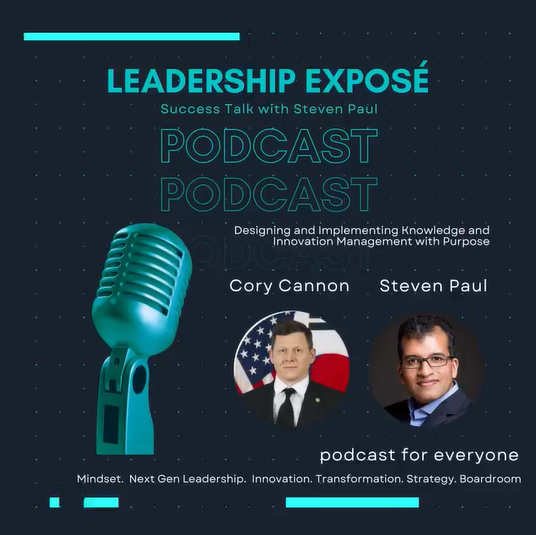
Mr. Cannon was recently on The Leadership Exposé Podcast: Success Talk with Steven Paul |
Episode 42: Cory Cannon: Designing and Implementing Knowledge and Innovation Management with Purpose

In this episode Steven PAUL, CDir FIoD (www.leadershipexpose.com) speaks with Cory Cannon, CKM Cannon, (Major Retired US Army Reserve), working as the Command Knowledge Leader at United Nations Command, Combined Forces Command, and United States Forces Korea (UNC/CFC/USFK) in South Korea. Cory brings diverse leadership experience, and accomplishments within and outside the military.

We will hear about Cory and learn.

✅ How he is leading Knowledge and Innovation Management 
✅ How he unlocks and embeds the pillars of People, Processes, Organizational Culture, and Tools
✅ Leadership intersections and lessons learned and applied in the military and commercial worlds

Tune in:
🎙Spotify: https://lnkd.in/eYsz8jUr
🎙Apple Podcasts: https://lnkd.in/ewEuewbA
🎙Google Podcasts: https://lnkd.in/eqc4F5Hg
🎙Amazon Podcasts: https://lnkd.in/eMt2tduQ
🎥YouTube VIDEO with Captions: https://lnkd.in/euqPUYTE
🌐Leadership Exposé Innovators Page: https://lnkd.in/eHR4t6n5

My friend Nick Milton from Knoco wrote this the other day on his blog. I think it has some great lessons that can be applied to the military community. ——- Knowledge stores need to determine the various validity levels of the knowledge they contain. Knowledge comes in different levels of trust, and you need to make it clear to the reader what level applies to the documentation they are reading.

There are three main levels:

  1. Mandatory, or “Must Do”. This is the level of company standards, and everybody reading this particular process documentation needs to be very clear that they need to follow exactly what’s written. If there is a major problem, they need to get in touch with the process owner and discuss it with them, but that the default should be to follow this documentation exactly.
  2. Advisory, or “Should Do”. This is the level of best practices, and everybody reading this particular process documentation needs to be clear that this is the best way to approach this particular process, based on current company knowledge. However there is always the possibility to improve on best practice, and if somebody can find an even better way, then that’s great. So Advisory process is advised, but not compulsory. However if people ignore advisory knowledge and things go wrong, some awkward questions may be asked.
  3. Suggested, or “Could Do”. This is the level of good ideas or good practices that others in the organization have used, which the reader should feel free to reuse or re-adapt to his or her own context.

These good ideas can still save the reader a lot of time and effort, but there is no real requirement to copy them. In BP drilling in the late 1990s, corporate process documentation was divided into these three levels of validity, and these were labeled Principles, Processes and Practices. This labeling made it very clear to the reader how much scope they had to vary the process from what was in the documentation. My colleague Tom, in his book Knowledge Management for Operations and Manufacturing, tells about the BP Operations Excellence toolkit, which illustrates this well. The BP Operations Excellence toolkit is structured around the level of validation that has been applied to the knowledge.

At one level there is the highly vetted, approved knowledge in the form of corporate standards and required practices, which are referenced under the heading ‘The BP Way’. At the opposite end of the spectrum is the knowledge in the Question and Response system, eCLIPS, which is totally unvetted. BP went a step further and provided a ‘health guide’ to the advice you were receiving. Captured knowledge is presented in a hierarchy, as follows; •The “BP Way” These tools describe the way BP does business (ie BP policy). This should be the first place to look when identifying ways (the “what” and “how”). •Good Practices These describe good practices identified for the relevant elements by either experience from operating assets or subject matter experts. •Community discussion forum

This section links you to any questions (and responses) that have been asked about the relevant element and allows you to ask the Community if you have been unable to find an answer in the toolkit. All entries are purely voluntary and are not validated by Subject Matter Experts. This hierarchy is very important as it gives the reader a sense of how reliable the knowledge might be. Thus if the advice provided is in the form of The “BP Way” then the reader knows that this is a fully validated and approved policy or procedure and can be followed with confidence. At the bottom end of the scale, advice provided via the community forum, which is not validated, needs to be treated with a lot more caution.

Earlier in 2021 I presented to US CYBER COMMAND via Teams on why organizations should have a Knowledge Management Strategy. This KM Strategy should be centered on the organization’s mission and vision then branch out to the strategic objectives (3-5 years). The KM Strategy is that roadmap the organization can use to go from a reactionary organization to a learning organization.

Mr. Cannon’s Presentation to US CYBERCOM

Over this Covid-19 pandemic, I have been looking forward to being able to make those business to business networking connections again and gain more clients. One of the most important thing I have learned from this experience is how Knowledge Management can be done with your family.

The four pillars of Knowledge Management are People, Process, Organizational Culture and Tools. Applying these to your everyday day life can help with a multitude of things from the kids school and activities schedules, bills, doctors appointments, work schedules (yes even when WFH).

The people part of this equation is easy (your family) and each person has a role they play in the family unit. This includes doing the dishes to feeding the animals. Establishing what each person does helps manages what needs to be completed.

Process like it or not is just as important in the business arena as in the home. Processes on how bills are paid, what the approval process is for the kids to be able to get time on their Xbox or electronic devices. Establishing a clear process for your family on how things gets accomplished can help get things done more effectively.

Organizational culture, the family unit is a culture on its own. You have the parental unit(s) as well as the kid(s) and there is a definite cultural dynamic that comes into play on how situations are dealt with on a daily basis.

Tools so how do you keep your family organized, connected and be able to still be able to live. In my home, we utilize Microsoft Office products to include SharePoint and Outlook to keep our documents, bills and other important information where we can collaborate on any decisions that need to be made or have access to our information while we are out in the community. Another tool we use a lot of is whiteboards. I have a Kanban board to monitor my business and we have boards all thought out the house for kids chores, tracking medication, important events and bills. We also take handwritten notes exclusively on Rocketbook notebooks. In terms of our digital meetings we rely on Fireflies to capture audio notes which it does have the capability to transcribe the notes in order to search for information after the fact.

Looking back from the beginning of this pandemic until now, my family and I have gotten closer as well as become better stewards of our Knowledge that each of us has. We are also communicating better as a family.

If you our your company would like to know how Knowledge Management can help improve your business and your bottom dollar. Please feel free to contact me via email at cannonco@cannonco.net or by phone at 620-719-6004.

Since March, I have been asked how can Knowledge Management help me (or my company) to control this or any pandemic. The answer I give them is to treat this pandemic like any other operation your company was in prior to the pandemic but your environment now has some more barriers to overcome before your clients can get to purchase your goods or services.

Part of this is to be aware of the environment we are all facing. Be aware of the trends and where the outbreaks are occurring. A good source of information is the John’s Hopkins University COVID-19 Tracker

Another source of information is the Center for Disease Control where they give advice on how to protect yourself and others from this disease. Also your state and local governments have policies in place to help prevent the spread.

So what are other ways Knowledge Management can help contribute to the larger fight against this particular problem. The work from home or remote work policies for companies need to be reviewed and updated to make sure both quality of service as well as the internal information the employees share can be accessed wherever they are located. Even after this pandemic has run its course, companies should practice how to operate outside of the office spaces. This is something the corporate world can learn from the military.

Having operated in Iraq, Kuwait, Korea, Malaysia, Japan and other areas in the world I can honestly say that the most meaningful take aways were those times we operated outside of the normal headquarters and worked in either a combined environment with the host nation or joint environment with the other services. We all learned from each other and this was also done in remote areas away from the cubicles.

Mr. Cannon did a second podcast with Mr. Edwin K. Morris of Pioneer Knowledge Services on the topic of Education in Knowledge Management. In this podcast, Mr. Cannon explains his journey in academia to get training in Knowledge Management.

Discover what academics look like in the knowledge management field. Mr. Cannon chats about his experience as a student and teacher.

Mr. Cory Lee Cannon is a Certified Knowledge Manager and is with Cannon-Lear Enterprises and KnocoTexas.

Recorded 5 NOV 2019

Listen to Pioneer Knowledge Services – Because You Need To Know With Guest Cory Cannon 2019 by Edwin K. Morris on #SoundCloud or on #Spotify

https://open.spotify.com/episode/7vYhCmbfvoKNzcZDt12lpP?si=abK_Dpr1Q_ivbupejRb3wQ#_=_

Back in May our President and CEO (Mr. Cory L. Cannon) was asked to do an interview with Edwin K. Morris, President and Founder of Pioneer Knowledge Services. The main topic was Integration of organizational elements create a knowledge culture. Mr. Cannon tells about the inspiration and view his experience brings to KM. The interview SoundCloud or Spotify

https://open.spotify.com/episode/6bi9NnN48IqhFOlCud5a7d
(more…)

Sitting in the middle of the Kuwait desert at an undisclosed location. Members of 62 nations came together to pull their resources together against the members of Daesh who were causing havoc within a recovering Iraq and Syria. How did the members of these 62 nations from different backgrounds and culture come together to fend off these rebels out of Iraq and Syria? It was coming together in terms of what each of them can contribute to the effort (money, ground troops, planes, supplies, equipment, intelligence, etc.). These contributions allow the representing nations a certain need to know for issues within their agreed to contribution.

A few thousand miles away in Seoul, an Armistice “cease fire” has been going on for the past 65 plus years. There are three separate commands involved with maintaining the Armistice the United Nations Command (UNC), Combined Forces Command (CFC), and United States Forces Korea (USFK). Each of these commands have separate missions but they are all lead by one single U.S. Four Star General it has been this way since 1978. The United Nations Command is composed of 21 sending state nations who provide a representative or resources to the Command. The Combined Forces Command is a bilateral command between the Republic of Korea and the United States military. United States Forces Korea is the joint forces of the United States (Army, Navy, Air Force, Marines, and Special Operations) lead for national interest as well as the lead organization under United Nations Command (it is a very unique relationship).

As you can see, both situations are similar in terms of how they are structured and the need for maintaining the coalition as well as completing the mission without compromising vital information that would get passed to the advisory (either inadvertently or maliciously). So, the question remains how can a Commander get the vital information they need to make the correct decision at the appropriate time and maintain both the national interest as well as maintaining the coalition. This balancing act can be done through a variety of methods but the one that I have seen most effective is through meeting management.

Figure 1 depicts on what the audience should be within the meeting being held. If the information is similar or related, then you can have one meeting starting with inviting all the members of the coalition first and as the information gets more and more restrictive take a short break and excuse those members that are not privileged to the information. This will do two things. First, this construct fosters communication and information sharing with the members of the coalition, thus making all the members of the coalition feel that they have a say n the decision-making cycle. Second, it allows both the Commander and their staff more white space within their calendar to do the jobs they were slotted to perform

Table 1 shows an example agenda of how the meeting can be executed. As one can see going through the topics in this manner can save the entire staff time as well as give the decision-maker the information from multiple viewpoints that can affect the mission, the decision and ultimately lives that are out in the front lines implementing these directives.

When one develops the architecture for how the meetings will run for a multi-hatted Commander one has to be cognizant of the needs of the coalition, needs of the staff and most of all the needs of the Commander.

A United States,​ Department of Defense perspective on the distinction between Knowledge and Information, and what this means for KM within the DoD. After personally working on the Department of Defense Instruction for Knowledge Management for the past 4 years I am proud to say that we have agreed on a definition for Knowledge Management and the Instruction will soon be published.

The DoD will define Knowledge Management as a discipline focused on integrating people and processes enabled by tools, throughout the information lifecycle, in order to create shared understanding and increase organizational performance and decision-making.
In contrast, the DoD defines information management as the function of managing an organization’s information resources for the handling of data and information acquired by one or many different systems, individuals, and organizations in a way that optimizes access by all who have a share in that data or a right to that information.

Thus within the DoD Information Management is more on how to gather and access the data where Knowledge Management is taking that data and turning it into organizational shared  understanding that can be utilized for decision making.

One of the many services that Knoco Kansas provides is Communities of Practice Services to organizations these services range from launching a community, gauging the maturity, as well as training and coaching community leaders and facilitators. Communities of Practice are one of the pillars of a solid Knowledge Framework. Many government agencies like the FBI, DoD and NASA have created Communities of Practices ranging from topics as proposed administrative rules and regulation changes to creating entire processes and procedures that are scenario based.

Community of Practice

We help you get your Communities of Practice off to a flying start, through facilitating a one-day or (ideally) two-day launch program. This will be a mixture of introducing the structure and theory of the Community of Practice, and Community of Practice discussions around key topics.

We can check and track the health of your Communities of Practice, through applying a ten-component maturity assessment framework. This Community maturity assessment not only gives you a benchmark to measure development against, but also identified those factors that need the most attention.

We can train your Community leaders and facilitators in the effective operation of Communities of Practice, and how they deliver value to the business, through a combination of theory, case studies, and exercises working on your own Community of Practice issues. 

We can coach your Community leaders and facilitators in building and sustaining their Communities of Practice. Community leadership is a demanding task, and we offer to support the Community Leaders either through regular coaching visits, or through remote coaching through email, teleconferences and Skype.

Below are links to more in depth information on each of these services within Community of Practices please feel free to browse through them if there is any more information you want please feel free to contact me at cory.cannon@knoco.com 

Launching Communities of Practice

Knowledge Management Training Course List

Knowledge Management Coaching

Cory Cannon

Cory Cannon Certified Knowledge Manager Cannon-Lear Enterprises L.L.C.

Hello my name Cory Cannon of Cannon-Lear Enterprises L.L.C., which is an affiliate of Knoco Ltd. Just few bits of information about myself. I have been in the military (between the United States Marine Corps the United States Army and Army Reserves) for 17 years this year and have worked as a Department of Army Civilian at the Center for Army Lessons Learned for 3 years. During that time I have deployed twice to Iraq to conduct logistical convoys, and focus on Knowledge Management activities for the Senior Logistics Command in Iraq.

I received my Certified Knowledge Manager certification through the International Knowledge Management Institute and have taken the Army Knowledge Management Qualification Course to receive the additional skill identifier of Knowledge Management Professional. Academically, I have a bachelor degree in Political Science from Emporia State University a master’s degree in Political Science from Fort Hays State University and currently a PhD student at Bangkok University in the area of Knowledge and Innovation Management.

As a retired Major in the United States Army Reserves, I was the Knowledge Management Officer of a General Officer Command assisting with the Department of Defense and Joint Staff with developing Knowledge Management career path for both military and civilian government employees. I am also a PhD Graduate Assistant at Emporia State University where I supervise the School of Library and Information Management’s technology support desk as well as preform Knowledge Management assessments.

The services I conduct for Knoco Ltd are listed in the graphic below

KM_Wheel-Image

Knoco Ltd. KM Service Wheel

If you would like to have more information on any of these services please feel free to contact me at cory.cannon@knoco.com

Through my years working in Knowledge Management in both the military and civilian realms, one of the items that always comes up is the importance of governance for the program. Establishment of clear expectations for how Knowledge Management program will work in the organization provides that much needed guidance for the Knowledge workers in the company.

There are three simple things to consider when developing these expectations:

Ensure your Knowledge Management policy follows the mission and vision of the organization. Having your governance nested with the mission and vision links your program to the larger strategic goals of the company and gains that crucial buy-in from the Corporate Levels of the company.
Include a statement from the leadership expressing the importance of the program. This can be a simple one page forward or memorandum from the person who is either the company president or the person who acts in the Chief of Staff role for the organization. This statement gives validity to your program and shows the middle management they need to take this policy seriously.
Understand who is your audience: If your company is at one location with only local individuals then KM governance and a KM policy are relatively easy to develop. However, if the organization involves multiple locations and especially different cultures, these have to be kept in consideration.

These considerations, no matter if the organization is only 50 people from the local neighborhood or 50,000 people from 64 nations gives the focus on your program and the importance it is not only to yourself but how it affects the entire mission of the company.

Contact us for help in defining your own KM policy. Or click here for the February edition of the Knoco Ltd Newsletter