I recently went back through my blogs and emails and realized that I did not uphold a promise that I made to Tori back a couple of years ago. That is to review her book Mastering Knowledge Management Using Microsoft Technologies: Secrets to Leveraging Microsoft 365 and Becoming a Knowledge Management Guru by Tori Reddy Dodla. As someone who has spent a great deal of time working at the intersection of Knowledge Management, technology, governance, and organizational performance, I found this book both timely and useful.

What I appreciated most is that the book addresses a very real challenge many organizations face today. Most organizations already have Microsoft 365, SharePoint, Teams, Power Platform, Power BI, and now Copilot somewhere in their environment. Yet many of those same organizations are still struggling with knowledge silos, inconsistent document management, poor search experiences, weak reuse of lessons learned, and fragmented collaboration practices.

That is where this book provides value.

Rather than treating Knowledge Management as an abstract concept or presenting Microsoft 365 as just another technology stack, Dodla brings the two together in a practical way. The book helps readers think through how the Microsoft ecosystem can support knowledge capture, organization, sharing, analysis, and reuse. For many KM practitioners, SharePoint administrators, digital transformation leads, and business leaders, that alone makes the book worth reading.

The strength of the book is its practicality. It does not try to overcomplicate the conversation. It walks readers through how Microsoft tools can be used to build knowledge bases, manage documents, automate processes, visualize knowledge-related data, and improve access to organizational knowledge. The inclusion of Power Apps, Power BI, Power Platform, and Copilot makes the book especially relevant given where the workplace is heading.

That said, my honest view is that this book is strongest as a technology-enabled KM implementation guide. It is not, and should not be viewed as, a complete enterprise Knowledge Management strategy. That distinction matters.

Knowledge Management is not created simply because an organization has SharePoint. It is not solved by creating a Teams channel. It is not achieved by deploying Copilot. These tools can absolutely support KM, but they do not replace the need for strategy, governance, ownership, culture, taxonomy, metadata discipline, lessons learned processes, communities of practice, or leadership accountability.

In other words, Microsoft 365 can enable Knowledge Management, but it cannot do the hard organizational work by itself.

That is not a criticism of the book as much as it is a caution for the reader. If you are looking for a practical guide to better use the Microsoft tools your organization likely already owns, this book is a strong resource. If you are looking for a full KM maturity model, enterprise governance framework, or deep treatment of KM culture and behavior change, you will want to pair this book with broader KM literature and practical consulting guidance.

Another point worth noting is that Microsoft technologies are changing quickly. Copilot, SharePoint Premium, Viva, Purview, Teams, and the Power Platform continue to evolve. Because of that, readers should treat the book as a strong foundation rather than a final technical playbook. The concepts will remain useful, but the specific technical steps should always be checked against the latest Microsoft guidance.

Overall, I found Mastering Knowledge Management Using Microsoft Technologies to be a timely, practical, and valuable contribution. It speaks directly to organizations that are trying to get more value from Microsoft 365 while improving how knowledge flows across the business. For KM professionals working in Microsoft-heavy environments, this book offers a helpful bridge between KM intent and technology execution.

My rating would be 4 out of 5 stars.

It earns that rating because it is practical, relevant, and useful. I would not give it a full 5 because Knowledge Management is broader than any technology platform, and readers should be careful not to confuse Microsoft configuration with enterprise KM maturity. Still, for the right audience, this is a book I would recommend.

Final Thought

If your organization already uses Microsoft 365 but still struggles to find, trust, share, and reuse what it knows, this book is worth your time. Just remember that the technology is only part of the solution. The real work of Knowledge Management still comes down to people, process, governance, culture, and leadership.

After more than two decades immersed in Knowledge Management across military, government, consulting, and corporate environments, I have learned one consistent truth: Knowledge Management is not a buzzword, and it is not a software deployment.

Knowledge Management is a strategic discipline that helps organizations learn faster than their environment changes. It strengthens decision making, reduces preventable rework, improves mission and operational performance, and protects hard won expertise from walking out the door.

If you want a simple definition that works in the real world:

Knowledge Management is the deliberate way an organization creates, curates, shares, applies, and improves what it knows, so people can make better decisions and deliver better outcomes.

That is the difference between “we store information” and “we operate with organizational intelligence.”


The 5 Pillars of Knowledge Management

Over time, I have seen countless frameworks and maturity models. Most work when they are grounded in execution. In practice, KM stands on five pillars that must reinforce each other.

1. People

KM starts and ends with people.

Tools do not share knowledge. People do. The highest performing environments make it easy and safe for people to:

  • Ask questions without penalty
  • Share lessons without blame
  • Teach others without losing status
  • Challenge assumptions with respect
  • Build networks of trust across teams

When KM succeeds, it is because people are supported, recognized, and equipped to do knowledge work as part of normal work.

Practitioner signal: If knowledge sharing depends on heroic volunteers, it will not scale. Make it part of the job, the rhythm, and the incentives.


2. Process

Sustainable KM is built on repeatable processes that fit the operational cadence.

KM processes are not extra work. They are how you reduce waste and improve performance. Examples that consistently produce results:

  • After Action Reviews and Retrospectives that lead to updates in guidance, training, and standards
  • Peer Assists before major work to reuse what already works
  • Communities of Practice that solve problems and standardize good practice
  • Structured onboarding and proficiency pathways that reduce time to competency
  • Knowledge capture for critical roles, not as “interviews,” but as operational handovers

Practitioner signal: If you capture lessons but do not change how work is done, you have reporting, not learning.


3. Organizational Culture

Culture is the true engine of KM.

Where culture encourages openness and learning, KM thrives. Where culture rewards hoarding, KM becomes a checkbox. The cultural ingredients I see in strong KM organizations include:

  • Trust and psychological safety
  • Leaders who ask, “What did we learn?” and “What did we reuse?”
  • A norm that knowledge is an organizational asset, not personal property
  • A bias toward evidence, transparency, and continuous improvement

Culture is not posters and slogans. Culture is what happens when deadlines hit and things go wrong.

Practitioner signal: Watch what gets rewarded. If speed is rewarded but learning is punished, KM will always be fragile.


4. Tools and Technology

“Technology is an enabler, not the solution”.

Platforms like SharePoint, ServiceNow, Confluence, and enterprise search can be powerful. Yet without the other pillars, they become expensive filing cabinets.

In strong KM programs, tools are designed to make knowledge:

  • Findable: you can locate the best answer quickly
  • Usable: the content is written for action, not archives
  • Trusted: authoritative sources are clear, current, and governed
  • Embedded: knowledge appears in the workflow where decisions are made

If users must hunt across multiple systems, KM adoption will collapse under real work pressure.

Practitioner signal: Users do not want “more information.” They want the best answer, with confidence, at the moment of need.


5. Governance

Governance is the backbone that makes KM durable.

Governance is not bureaucracy. It is clarity. Good governance answers:

  • Who owns this knowledge domain
  • What is authoritative versus optional
  • How quality is reviewed and kept current
  • How access, privacy, and security are handled
  • How standards, taxonomy, and metadata are applied
  • How KM aligns to mission, strategy, and measurable outcomes

Without governance, KM becomes a collection of well meaning efforts that drift, duplicate, and decay.

Practitioner signal: If no one is accountable for knowledge quality and currency, your AI, analytics, and decisions will inherit that risk.

What is KM Infographic

KM Versus Information, Data, and Change Management

A lot of organizations struggle because they blur these disciplines. Each is essential, but they are not the same.

  • Data Management: Manages raw data, definitions, lineage, quality, and stewardship.
  • Information Management: Organizes documents, records, content, and retrieval.
  • Change Management: Prepares people to adopt new ways of working and sustain behavior change.
  • Knowledge Management: Integrates people, process, culture, technology, and governance so information and experience become actionable insight and improved performance.

A practical way to think about it:

Data becomes information when it is organized and contextualized.
Information becomes knowledge when it is interpreted, shared, and applied.
Knowledge becomes advantage when it drives better decisions and outcomes.

Example: SharePoint and ServiceNow can support information management very well. The KM value appears when you add learning processes, communities, validated knowledge assets, and governance that keep content accurate, discoverable, and operationally relevant.


The KM Outcomes Leaders Actually Care About

KM is not measured by the number of documents uploaded or pages viewed. Those are activity metrics, not outcome metrics.

KM creates value when it improves results such as:

  • Faster onboarding and reduced time to proficiency
  • Fewer repeat incidents and fewer preventable failures
  • Increased reuse of proven practices and reduced rework
  • Better decision quality through traceable rationale and evidence
  • Greater resilience during turnover, reorgs, or surge operations
  • Increased innovation by connecting expertise across silos

If you cannot connect KM to operational outcomes, the program will always be vulnerable at budget time.


KM in the Age of AI

AI has raised the stakes.

If your knowledge is ungoverned, outdated, duplicative, or difficult to trace back to authoritative sources, AI will amplify that problem. Many organizations are learning that AI readiness is less about the model and more about the knowledge foundation.

In practice, modern KM must support:

  • Source grounded answers and citations to authoritative knowledge
  • Clear ownership and lifecycle management
  • Content quality controls and review rhythms
  • Taxonomy and metadata that improve retrieval precision
  • Decision records and rationale that support auditability

AI does not replace KM. AI makes KM non negotiable.


Closing Thought

KM is not a one time initiative or a plug and play solution. It is a capability that grows with practice, leadership commitment, and disciplined execution.

If your organization is ready to move beyond storing information and toward building real organizational intelligence, I would welcome the conversation.

Question for you: Which pillar is the strongest in your organization today, and which one is the biggest constraint?


“Don’t Buy the Tool Before You Know the Terrain: Why Every Organization Needs a Knowledge Assessment First”

In today’s digital rush, organizations often jump head-first into implementing new technologies. AI systems, data lakes, collaboration platforms, or analytics dashboards, with CEO, CTO, and other C-Sutie officials believing that the right tool will automatically solve their knowledge problems. However, this approach can be likened to buying expensive gym equipment without ever assessing your fitness goals, capabilities, or habits.

A recent client’s feedback captured this mindset succinctly:

“I was disappointed by the absence of technological integration in the proposal…”

This sentiment reveals a common misconception that technology is strategy. Technology is only an enabler, not the foundation of effective Knowledge Management (KM).

What a Knowledge Assessment Actually Does

A Knowledge Assessment is a structured evaluation of how an organization creates, shares, stores, and applies knowledge to achieve its objectives. It identifies critical enablers and barriers across four domains: People, Processes, Technology, and Culture.

Without this diagnostic phase, even the most advanced technology investments risk failing because they do not align with how knowledge flows within the organization. ISO 30401 (the international KM standard) emphasizes this alignment as the first step in building a sustainable KM system (ISO, 2018).

Why Organizations Skip It

Organizations often skip the assessment stage for three reasons:

  1. Perceived urgency: leadership wants quick wins.
  2. Vendor influence: solution providers market platforms as “plug-and-play.”
  3. Budget optics: assessments are seen as overhead, not as value creation.

The irony is that skipping the assessment usually costs far more in the long run. Research by Davenport and Prusak (1998) shows that up to 70% of knowledge initiatives fail when technology precedes strategy or assessment. Similarly, McKinsey (2020) found that firms that perform up-front knowledge audits see three times higher adoption rates for digital platforms.

Lessons from the Field

At Knoco, we have observed that organizations that neglect knowledge assessments often face predictable outcomes:

  • Misaligned technology that doesn’t fit business workflows.
  • Poor adoption because staff don’t see value.
  • Data duplication, versioning issues, and knowledge silos.
  • Reimplementation costs when the platform fails to deliver.

The client quoted earlier, for example, prioritized technology over knowledge diagnostics. Six months later, their project stalled due to low engagement and unclear ownership. Symptoms that a proper Knowledge Assessment would have revealed early.

The Hidden ROI of a Knowledge Assessment

A Knowledge Assessment is not a cost; it’s a risk-mitigation investment.
Its outcomes provide:

  • A baseline for measuring maturity and readiness.
  • A blueprint for aligning KM strategy to business goals.
  • A gap analysis identifying where people, processes, and technology must evolve.
  • A change management roadmap that ensures adoption, not just installation.

Organizations that conduct these assessments typically reduce technology rework costs by 30–50% (Gartner, 2022) and experience higher user engagement within the first 90 days post-implementation.

Technology Should Follow Knowledge

The Knowledge Assessment informs us what technology is truly needed, not what looks modern or impressive. For instance:

  • If tacit knowledge is the biggest gap, invest in collaboration tools and communities of practice.
  • If explicit knowledge is poorly managed, strengthen content governance before upgrading platforms.
  • If decision latency is the issue, integrate AI-enabled analytics after data and process alignment.

The right tool will emerge naturally once the knowledge ecosystem is understood.

Conclusion: Start with Knowledge, End with Intelligence

Every digital transformation begins with a deceptively simple question:
“Do we know what we know?”

Without that clarity, no amount of technology can make an organization smarter. As the saying goes in Knowledge Management: “You can’t automate what you don’t understand.”

Conducting a Knowledge Assessment first ensures that technology becomes a multiplier of human intelligence, not a substitute for it.

Every year globally connected KM practitioners, networks and organizations pause for a moment of alignment, sharing and celebration in what we now recognize as Global Knowledge Management Week (KM Week). This event provides a focal point for raising the visibility of knowledge management (KM) as a discipline, reinforcing its relevance across sectors and geographies, and encouraging coordinated activity, dialogue and reflection.

Origins and Evolution

The seed of this global “week of KM” belongs to the Knowledge Management Global Network (KMGN), a not-for-profit network of international KM communities. KMGN was founded in 2014 and institutionalized in 2021. (kmglobalnetwork.org)
Via KMGN and its partner communities, the notion of a “KM Week” or “KM Festival” emerged as a way to bring regional, national and organizational KM activities into a common timeframe and amplify their impact. For instance, KMGN describes “Global Knowledge Week” as being organized since 2023 under that banner. (KMedu Hub)
More broadly, RealKM Magazine reports that in 2024, there were 138 events across 16 countries as part of the 2024 edition of KM Week — signaling meaningful traction and global spread. (RealKM)

Thus, what began as a network-driven coordination effort has matured into an annual “festival of KM” that invites knowledge professionals everywhere to plan events, share case studies, explore emerging topics (such as AI, tacit knowledge, knowledge graphs, decolonizing knowledge) and connect across borders.

Why It Matters

From my vantage, having worked in knowledge management in the military, government and private sectors, KM Week is powerful for several reasons:

  • It raises awareness of KM’s strategic importance in organisations and ecosystems (not just as a “nice-to-have” but as a value driver).
  • It creates a focal point for KM professionals to synchronise efforts, share best practices, and challenge themselves with new themes.
  • It elevates innovation and future-oriented thinking in KM (for example: how do generative AI, knowledge graphs, and contextual ontologies alter KM strategy?).
  • And it fosters a sense of global community among KM practitioners, which supports sharing across cultural, organisational and national boundaries.

For someone working at the intersection of knowledge management, innovation and data management (in my case across defense, government and industry), KM Week serves as a useful anchor to reflect on where we stand as a KM Community, what is working, where the gaps are, and how to advance from “data → knowledge → decision” loops in increasingly complex environments.

What is the Agenda for KM Week 2025?

Here are the key details for this year’s edition, plus how organizations and practitioners might engage proactively.

Dates & Participation

  • The 2025 edition of Global Knowledge Management Week is scheduled for October 20-25, 2025. (ROM Global)
  • The week is open: organizations, networks, communities and individuals are encouraged to plan events (online, in-person or hybrid) across regions, sectors and levels. (ROM Global)

Focus Themes
While the week itself is a “container”, a number of thematic tracks are emerging that reflect the current frontiers of KM. According to RealKM and other commentary: (RealKM)

  • Generative AI & KM: how AI agents, knowledge graphs and other “next-gen” tools intersect with KM practice.
  • Tacit Knowledge & Knowledge Capture: recognising that in many organisations critical knowledge remains tacit, embedded in human experience, often high-stakes as in defence or complex engineering.
  • Complexity, Systems Thinking & KM: acknowledging that knowledge flows in complex, dynamic systems and KM must adapt accordingly (e.g., project-based organizations, temporary organizations).
  • Decolonizing Knowledge & Knowledge Sovereignty: foregrounding culturally aware, inclusive approaches to KM that recognize diverse epistemologies and avoid extractive knowledge models.
  • Knowledge Governance, Standards & Measurement: as organisations mature in KM, questions of governance, ROI, standardisation (e.g., ISO 30401), and metrics become ever more relevant.
  • Communities of Practice, Knowledge Sharing & Innovation: emphasising collaboration, networks, peer-to-peer sharing and the link from KM to innovation outcomes.
  • KM in SMEs & Varied Sectors: KM does not just happen in large enterprises, need to look how KM practices adapt to smaller organizations, different industries (e.g., SMEs, project-based sectors, construction).

How to Get Involved – A Practitioner Checklist
For KM practitioners, leaders and innovation managers, here are suggested steps:

  1. Schedule a kickoff: coordinate within your organisation (or network) a KM Week event, even a short webinar or panel, for the Oct 20–25 window.
  2. Select a theme: pick one (or more) of the emerging tracks above that reflect your organisational context (e.g., AI-enabled knowledge capture in defence; tacit knowledge transfer in government).
  3. Invite cross-discipline input: involve stakeholders beyond KM (e.g., data management, AI/ML, innovation teams, decision-makers) to broaden the conversation.
  4. Capture insights: use the week as a “pulse check” to document what is happening, what gaps remain, what opportunities for improvement exist.
  5. Share out: report key take-aways internally and externally (e.g., LinkedIn post, blog) to build momentum and visibility for KM in your ecosystem.
  6. Link to strategy: tie the event back to your broader KM/innovation/data management strategy, this is not just a standalone event but a gateway to future action.
  7. Engage the global KM community: connect with KMGN, share your event, and see what others are doing globally – the value lies in cross-pollination too.

A Personal Note

In over 20 years of working at the convergence of knowledge management, data management and innovation (especially in defense, government and industry), I have seen how historically knowledge functions were often relegated to support roles. But the accelerating pace of change, driven by digitalization, AI, networked operations and hybrid work, this means KM is now mission critical for all organizations. KM Week provides an ideal moment to step back, reflect on progress and lean into the future.

As we enter KM Week 2025, I encourage you to treat it not just as a calendar event, but as a strategic opportunity: to align your knowledge agenda with innovation, put tacit knowledge into play, govern effectively, and connect to broader ecosystem-thinking. Your organization (and your network) will be better for it.

Let us make this KM Week 2025 one of purposeful alignment, global connection and future-oriented action.

Ever wonder how other knowledge and information (K&IM) professionals work? How did they get into K&IM and to their current position? You will get a glimpse in this interview series with K&IM professionals, “In Conversation with…,” and perhaps even discover potential candidates for your career mentor.

June Huang, K&IM professional, CILIP K&IM group committee member, London, UK

https://www.linkedin.com/pulse/conversation-cory-lee-cannon-june-huang-ssv5e

The allure of Artificial Intelligence (AI) as a transformative capability is undeniable. From predictive analytics and intelligent automation to cognitive assistants and generative AI, organizations across sectors are racing to implement AI-driven solutions. Yet, such transformations often occur without addressing foundational questions related to knowledge, data governance, and organizational readiness. Knowledge Management (KM) serves as the bridge between human cognition and machine intelligence, converting disparate information into structured, contextualized, and actionable insights—elements critical for the success of AI.

Deploying AI without a KM framework is akin to attempting complex reasoning in a vacuum devoid of context, meaning, and organizational memory. Knowledge assets—both tacit and explicit—must be curated, governed, and integrated into a cohesive enterprise knowledge ecosystem to support machine learning and decision augmentation initiatives effectively.

Understanding the Intersection of Knowledge Management and Artificial Intelligence

AI algorithms require extensive training on reliable, high-quality data to be effective. However, data is not synonymous with knowledge. Data must undergo a transformation journey—through processes such as contextualization, validation, interpretation, and application—to become knowledge and, eventually, insight and understanding. This transformation lies at the heart of KM.

Knowledge Management is a discipline focused on integrating people and processes enabled by tools throughout the information lifecycle in order to create shared understanding and increase organizational performance and decision-making.

Artificial Intelligence, meanwhile, refers to systems capable of performing tasks that normally require human intelligence, such as learning, reasoning, problem-solving, and perception.

Without KM, AI systems may:

  • Reinforce biases in data.
  • Lack domain-specific context.
  • Misinterpret organizational goals.
  • Deliver decisions lacking transparency or trust.

A robust KM program addresses these challenges by ensuring that data is meaningful, context-aware, governed, and aligned with organizational intelligence.

Benefits of Implementing Knowledge Management Before AI Deployment

Enhanced Data Quality and Contextual Relevance

AI’s predictive and analytical power is only as good as the data it is trained on. KM facilitates the curation of high-quality, context-rich data. Through knowledge audits, taxonomy development, and metadata tagging, KM provides the contextual layers that AI needs to learn effectively.

KM ensures that:

  • Data is contextualized within organizational processes.
  • Terminologies and taxonomies are standardized.
  • Historical knowledge and lessons learned inform AI model design.

Case Example: In healthcare, AI systems trained on raw EHR (Electronic Health Record) data without contextual medical knowledge have led to dangerous misdiagnoses. KM frameworks that include clinical guidelines and practitioner knowledge have been shown to improve model interpretability and accuracy.

Accelerated Knowledge Discovery and Transfer

AI benefits significantly from access to codified knowledge, especially in organizations where critical knowledge is tacit or tribal. KM facilitates the conversion of tacit knowledge into explicit forms via after-action reviews, expert interviews, and digital repositories.

This captured knowledge can then be leveraged by AI systems to:

  • Enhance semantic search capabilities.
  • Improve natural language understanding.
  • Enable intelligent recommendations.

By enabling structured knowledge capture, KM reduces the risk of “garbage in, garbage out” that plagues many AI deployments.

Improved Governance, Risk Management, and Ethical Oversight

A KM program establishes a governance framework for information flows, access, and use—critical considerations when deploying AI. Without KM, organizations risk violating data privacy laws, misrepresenting facts, or implementing opaque decision-making processes.

KM contributes to ethical AI by:

  • Embedding data stewardship roles.
  • Defining knowledge ownership and lineage.
  • Integrating human oversight into automated decisions.

The European Commission’s Guidelines for Trustworthy AI emphasize knowledge transparency, traceability, and human agency—all functions that a KM program can structure.

Facilitating Human-AI Collaboration

AI augments, rather than replaces, human expertise. KM systems foster this synergy by embedding AI within human workflows, capturing feedback, and supporting iterative learning.

KM platforms such as expert locators, community of practice tools, and collaborative workspaces help:

  • Connect AI recommendations to subject matter experts.
  • Capture decisions and rationale for future training cycles.
  • Promote learning organizations and double-loop learning.

By enabling organizational learning loops, KM ensures that AI evolves with organizational knowledge, rather than in isolation.

Strategic Alignment and Change Management

Deploying AI without aligning it with strategic knowledge goals risks misaligned investment. KM helps identify core knowledge domains, critical knowledge workers, and strategic gaps.

Through knowledge mapping and stakeholder analysis, KM can:

  • Prioritize AI use cases based on knowledge value chains.
  • Support Change Management by addressing workforce impacts.
  • Build a culture of trust in machine-augmented decisions.

KM’s participatory approach ensures that AI is seen not as a threat but as a collaborative partner in achieving organizational goals.

Organizational Knowledge Loop Model as a Guiding Framework

The Organizational Knowledge Loop Model provides a practical roadmap for transforming data into decision-ready knowledge before AI is applied. The model progresses through:

  1. Data
  2. Authentication
  3. Information
  4. Intelligence
  5. Knowledge
  6. Insight
  7. Understanding
  8. Action

This cyclical flow ensures that AI systems operate within a structured, validated, and contextually enriched knowledge ecosystem.

For example:

  • Validation filters poor data and removes bias before training AI models.
  • Knowledge and Intelligence support inference and rule-based systems.
  • Insight and Understanding align AI outputs with organizational strategy.

Without this loop, AI becomes a black-box system producing outputs that may be technically sound but organizationally irrelevant.

Implementation Recommendations

To operationalize KM before AI deployment, organizations should:

  • Conduct a knowledge readiness assessment.
  • Establish a KM governance council integrated with data ethics boards.
  • Deploy Knowledge Capture Programs (e.g., exit interviews, knowledge elicitation workshops).
  • Develop a federated knowledge architecture that integrates with AI pipelines.
  • Educate leadership and staff on KM-AI interdependencies through continuous learning.

Adopting standards like ISO 30401:2018/Amd 2:2024 – Knowledge Management Systems can provide structure to these efforts.

Case Studies and Industry Examples

Lockheed Martin

Before introducing AI in its manufacturing lines, Lockheed Martin implemented a KM initiative to capture the knowledge of retiring engineers. This not only preserved critical design heuristics but significantly improved AI model training for predictive maintenance.

U.S. Department of Defense

The U.S. DoD has recognized KM as essential for mission planning, especially when integrating autonomous systems. The Joint AI Center (JAIC) emphasized KM programs to ensure AI was contextually aware of doctrine, environment, and strategic intent.

Procter & Gamble

P&G’s AI-driven product innovation success is credited to its KM backbone, which integrates consumer insights, R&D knowledge, and historical data in an enterprise-wide KM system that feeds into AI for forecasting and trend detection.

Conclusion

Artificial Intelligence holds transformational potential. However, deploying it without a Knowledge Management foundation is strategically shortsighted and operationally risky. KM provides the epistemic and organizational scaffolding that AI needs to generate value—ensuring data is transformed into intelligence, insight, and action that align with enterprise goals.

As organizations navigate the Fourth Industrial Revolution, integrating KM and AI not only enhances decision-making and innovation but ensures that technology serves humanity—not the other way around.

Have you ever wondered how big companies keep track of all their important information? It’s like having a super-organized digital library, and now we’re adding smart robots (artificial intelligence or AI) to help manage it all. This is called Knowledge Management (KM), and in 2025, it’s getting a major upgrade thanks to AI.

Why This Matters Think about how much information your phone or computer holds. Now imagine managing information for an entire company! It’s a huge task, but AI tools are making it much easier. Companies need these tools to stay competitive and make better decisions. It’s like having a really smart assistant who never forgets anything and can find information in seconds.

The Cool New Tools

Microsoft CoPilot: Your Digital Assistant Imagine having a helper who can write documents, take notes during meetings, and give you smart suggestions. That’s what Microsoft CoPilot does! It works with programs you might already know, like Word and Teams. When you’re working on a document, CoPilot can help you write better and faster. It’s like having a writing buddy who’s always ready to help.

ChatGPT: Your Question-Answering Friend ChatGPT is like having a super-smart friend who can answer almost any question. It can help you: – Find answers to tough questions – Write different types of content – Come up with new ideas The best part? It understands normal language, so you don’t need to use special computer codes to talk to it.

Ollama: Your Security Guard Some information needs to stay private and secure. Ollama is like a security guard for your company’s knowledge. It keeps sensitive information safe while still letting AI help you work with it. This is especially important for places like hospitals or government offices that deal with private information.

RAG Systems: Your Smart Library Think of RAG (Retrieval-Augmented Generation) systems as a super-smart librarian. They can: – Find information from different places – Put it together in a way that makes sense – Help you discover things you didn’t even know you had It’s like having a library where the books organize themselves and can tell you exactly what you need to know!

How to Make It Work in Your Organization

Step 1: Check What You Have Before adding AI to your knowledge management system, you need to know what you’re working with. It’s like cleaning your room before adding new furniture. You need to: – Look at how you currently handle information – Figure out what’s working and what isn’t – Decide what kind of AI tools would help the most

Step 2: Getting Started Once you know what you need, it’s time to set everything up. This includes: – Making sure your information is clean and organized – Adding the AI tools carefully, one step at a time – Testing everything to make sure it works right

Step 3: Teaching Everyone to Use It Having great tools doesn’t help if people don’t know how to use them. You need to: – Show people how to use the new AI tools – Help them understand why these tools are helpful – Make sure there’s always someone available to answer questions

Real-Life Examples

Making Documents Easier to Find:  AI can help organize documents automatically. It’s like having a robot that: – Labels everything correctly – Keeps track of different versions – Creates quick summaries This saves time and makes it much easier to find what you need.

Learning New Things: AI can help people learn in ways that work best for them. It’s like having a personal teacher who: – Knows what you need to learn – Understands how you learn best – Creates custom lessons just for you

Keeping Everything Safe: When using AI, it’s important to keep information secure. This means: – Using passwords and special permissions – Regularly checking that information is correct – Making sure private information stays private

Measuring Success: How do you know if the AI tools are helping? You need to: – Keep track of how much time people save – See if it’s easier to find information – Check if people are using the new tools

Looking to the Future: AI and knowledge management will keep getting better. New technologies will make it even easier to: – Find and use information – Learn new things – Work together as a team The key is to stay up-to-date and be ready to try new tools as they become available.

Adding AI to knowledge management is like upgrading from a regular library to the Jedi library where everything organizes itself and finds exactly what you need. While it takes some work to set up, the benefits are worth it. Companies that use these tools will be better prepared for the future.

Want to Learn More? If you’re interested in seeing how these AI tools could help your organization, we’d love to talk! We can look at your current setup and suggest the best ways to make AI work for you.

Remember: The future of knowledge management is here, and it’s smarter than ever. Are you ready to be part of it?

In today’s dynamic organizational landscape, decision-making has become more complex, requiring rapid access to vast amounts of information and the ability to process it in ways that lead to actionable insights. Knowledge Management (KM) and Artificial Intelligence (AI) offer critical tools in addressing this challenge. Both fields, when integrated effectively, create systems that enhance decision-making processes by combining human expertise with AI’s advanced data analysis capabilities. The intersection of KM and AI not only streamlines the flow of information but also augments the human ability to draw insights, thus fostering more informed, strategic, and timely decisions.

This article delves into the symbiotic relationship between KM and AI, exploring how their convergence aids decision-making. It will highlight how these technologies can be leveraged across different industries, analyze their impacts on data management processes, and discuss the implications of AI in transforming traditional KM practices.

The Convergence of Knowledge Management and Artificial Intelligence

The intersection of KM and AI represents the next evolution in decision-making. Knowledge Management, at its core, depends on the organization’s ability to capture, store, and share knowledge efficiently. However, the sheer volume of data generated in modern organizations has outpaced traditional KM systems, making it difficult to extract actionable knowledge manually. AI steps in to address these limitations by enhancing knowledge discovery, structuring unstructured data, and automating the decision-making process.

1. Enhancing Knowledge Discovery with AI

One of the most significant contributions of AI to KM is its ability to enhance knowledge discovery. Traditional KM systems rely heavily on the manual input of data, which limits the breadth and depth of available knowledge. AI, particularly through machine learning and natural language processing, automates the extraction of relevant knowledge from vast and varied data sources. This knowledge is then structured and made available in a way that is actionable for decision-makers.

For instance, AI can mine unstructured data—such as reports, emails, and social media—to identify patterns, trends, or insights that might have been overlooked. By tagging and categorizing this information automatically, AI allows KM systems to become more dynamic and responsive. Furthermore, AI can constantly learn from new data, ensuring that the knowledge repository remains up to date.

 2. AI as an Enabler for Decision Support Systems (DSS)

Decision Support Systems (DSS) have traditionally relied on human expertise and structured data to provide actionable insights. With the integration of AI into KM, DSS can be supercharged with real-time data analytics, predictive modeling, and simulation capabilities. AI-driven DSS can analyze complex datasets, identify patterns, and make recommendations faster and more accurately than traditional systems.

For example, in a military setting, where rapid decision-making is crucial, AI-enabled DSS can pull data from diverse sources, such as satellite imagery, reconnaissance reports, and past mission outcomes, to provide commanders with a comprehensive situational analysis. This not only speeds up the decision-making process but also improves the quality of decisions by reducing human biases and errors.

3. AI and Knowledge Personalization

Another critical area where AI enhances KM is in knowledge personalization. With AI, KM systems can tailor information delivery based on the role, preferences, and previous actions of users. AI algorithms can monitor users’ behavior and interactions with the knowledge base to provide personalized recommendations, like how online platforms suggest content based on past user interactions.

In an organizational context, AI can predict which knowledge assets are most relevant to a decision-maker based on their previous queries and decision patterns. This ensures that the most critical information surfaces in real-time, reducing the time spent searching for relevant data.

4. AI for Real-Time Decision-Making

AI’s capability for real-time data analysis and pattern recognition is transformative for decision-making processes. Traditional KM systems might be able to provide knowledge based on historical data, but AI can continuously analyze incoming information, detect anomalies, and provide real-time insights. This is especially beneficial in industries such as healthcare, finance, and defense, where decisions need to be made swiftly and accurately.

For example, in healthcare, AI-powered KM systems can analyze patient data in real-time to recommend personalized treatment plans based on both historical cases and current conditions. This dynamic decision-making process ensures that medical professionals have access to the most up-to-date and relevant knowledge when treating patients, improving outcomes and reducing risks.

5. Predictive Knowledge Management

One of the most powerful intersections between AI and KM is in predictive knowledge management. AI algorithms can analyze historical data to predict future outcomes, helping organizations to anticipate challenges and opportunities. This proactive approach to decision-making ensures that organizations are not just reacting to current events but are also preparing for future scenarios.

In industries like finance, predictive KM can be used to analyze market trends, customer behavior, and economic indicators to inform investment decisions. In the military, predictive KM systems can analyze intelligence data to forecast potential threats, enabling proactive measures to be taken before situations escalate.

Case Study: AI and KM in Military Decision-Making

To illustrate the practical application of AI and KM in decision-making, consider a military scenario involving a joint task force conducting operations in a conflict zone. Effective decision-making in this environment requires rapid access to diverse information sources, from satellite data and field reports to intelligence gathered from allied forces.

AI-Enhanced KM Systems: The task force’s knowledge management system, enhanced by AI, continuously ingests data from multiple sources, automatically categorizes it, and provides commanders with real-time updates on the situation. AI algorithms analyze patterns in enemy movements, weather conditions, and supply chain logistics to offer predictive insights on potential threats and opportunities.

Decision Support: Commanders use an AI-powered DSS that integrates knowledge from past missions, current intelligence, and predictive models to assess the risks and benefits of various courses of action. The system provides recommendations based on probabilistic outcomes, allowing commanders to make informed decisions quickly.

Real-Time Adaptation: As the operation unfolds, the AI system monitors new intelligence and battlefield conditions in real-time, continuously updating its analysis and recommendations. This ensures that commanders have the most accurate and relevant information, even as the situation evolves.

By integrating AI with KM, the military task force is able to make faster, more informed decisions, reducing risks and improving operational effectiveness.

Challenges and Considerations

While the integration of AI and KM presents numerous advantages, it also comes with challenges that organizations must navigate to achieve optimal results.

1. Data Quality and Availability

AI’s effectiveness depends on the quality and availability of data. Incomplete or inaccurate data can lead to flawed insights and poor decision-making. Organizations must ensure that their KM systems are fed with clean, comprehensive, and up-to-date data for AI algorithms to function effectively.

2. Ethical and Security Concerns

The use of AI in decision-making raises ethical and security concerns, particularly when it comes to sensitive data. Organizations must implement robust security measures to protect their knowledge assets and ensure that AI systems are used responsibly. Additionally, there is a need to address issues of transparency and accountability, as decisions made by AI systems may not always be easily explainable.

3. Human-AI Collaboration

The goal of integrating AI with KM is not to replace human decision-makers but to augment their capabilities. Organizations must focus on fostering collaboration between AI systems and human experts, ensuring that AI serves as a tool for enhancing human judgment rather than supplanting it.

4. Change Management

Implementing AI-driven KM systems requires a shift in organizational culture and processes. Employees must be trained to use new technologies effectively, and organizations must be prepared to manage the changes that come with AI adoption, including potential disruptions to existing workflows.

The Future of AI and KM in Decision-Making

The convergence of Knowledge Management and Artificial Intelligence represents a paradigm shift in decision-making processes. AI enhances the ability of KM systems to capture, analyze, and share knowledge in real-time, enabling organizations to make more informed, data-driven decisions. As AI continues to evolve, its integration with KM will become increasingly critical for organizations seeking to remain competitive in a fast-paced, data-driven world.

By harnessing the power of AI and KM together, organizations can move beyond reactive decision-making and embrace a more proactive, predictive approach. This shift will not only improve operational efficiency but also drive innovation and strategic growth in ways that were previously unimaginable.

The future of decision-making lies at the intersection of human expertise and artificial intelligence, where knowledge is not just managed but actively leveraged to anticipate and shape the future. As organizations continue to explore this intersection, the possibilities for innovation and improvement in decision-making processes are limitless.
Knowledge Management (KM) program in a toxic organizational climate presents unique challenges. A toxic environment, characterized by distrust, poor communication, and conflicting interests, can hinder the free flow of information and knowledge critical for organizational learning and innovation. Here are five ways to successfully implement and run a KM program in such settings:

1. Establish Trust through Transparent Communication in a toxic climate, building trust is paramount. Start by implementing transparent communication practices. This involves openly sharing the goals and benefits of the KM program with all team members, addressing their concerns, and involving them in decision-making processes. Regular updates about the progress of the KM initiatives and how they contribute to the organization’s goals can also build credibility and trust.

2. Foster a Culture of Collaboration and Inclusion Transforming the organizational culture from toxic to collaborative requires intentional efforts to include all employees in the knowledge sharing process. Create cross-functional teams that bring diverse groups together to work on common problems or projects. This not only helps break down silos but also encourages a culture where shared knowledge leads to shared success. Recognizing and rewarding collaborative behaviors can further reinforce this shift.

3. Implement Robust Change Management Practices Resistance to change is often heightened in a toxic environment. To manage this, robust change management practices are necessary. This includes educating employees about the value of KM and providing them with the necessary training to utilize KM tools and processes effectively. Addressing fears about job security or increased workload due to new KM practices can also mitigate resistance.

4. Leverage Technology to Facilitate Knowledge SharingIn an environment where face-to-face interactions may be strained, technology can play a crucial role. Implementing user-friendly KM systems that facilitate easy access and sharing of information can help overcome interpersonal hurdles. These systems should be secure, intuitive, and accessible, allowing employees to contribute and access knowledge without unnecessary barriers.

5. Monitor, Evaluate, and Adapt Continuous monitoring and evaluation of the KM program are crucial, especially in a challenging environment. This involves setting clear metrics to evaluate the effectiveness of KM practices and making adjustments as needed. Solicit regular feedback from employees to understand their challenges and successes, using this data to fine-tune the program. Being responsive to the needs and dynamics of the organization can help ensure the KM program evolves and remains relevant.

Conclusion

Implementing a KM program in a toxic organizational climate is challenging but not insurmountable. By focusing on building trust, fostering collaboration, managing change effectively, leveraging technology, and continuously adapting to feedback, it is possible to create a successful KM environment. These strategies not only mitigate the effects of the toxic environment but can also contribute to its transformation into a more positive and productive space.For organizations determined to overcome a negative climate, these steps provide a strategic framework to harness the power of knowledge management for sustainable change and growth.

I get asked a lot about what books in the vast galaxy of Knowledge Management do I recommend. There exist powerful tomes that illuminate the path towards effective organizational knowledge stewardship. This article delves into the wisdom encapsulated within twelve pivotal books that have significantly contributed to the discipline of Knowledge Management.

Each of these works has left an indelible mark on the landscape of understanding and implementing Knowledge Management strategies. The insights derived from these literary gems not only enrich the field of study but also serve as beacons for practitioners seeking to navigate the complexities of managing knowledge within diverse organizational settings. I have provided links to the books in order to add to your collection.

This book presents a fresh perspective on revitalizing the Knowledge Management movement. The authors advocate for a dynamic and adaptive approach, emphasizing the need to continually renew and evolve knowledge practices to remain relevant in an ever-changing environment.


In “The Knowledge Café,” Anyacho introduces the concept of the Knowledge Cafe as a platform for fostering open conversations and collaborative knowledge sharing. This book provides practical insights into creating spaces where individuals can engage in meaningful dialogue, leading to the organic development of shared knowledge within an organization.


Milton and Lambe’s “The Knowledge Manager’s Handbook” serves as a comprehensive guide for Knowledge Managers. Drawing from their extensive expertise, the authors cover essential topics such as knowledge capture, transfer, and utilization, providing a practical roadmap for those entrusted with managing an organization’s intellectual capital.


Barnes and Milton explore the intricate process of crafting a successful Knowledge Management strategy in their book. “Designing a Successful KM Strategy” offers practical frameworks and methodologies to help organizations align their knowledge initiatives with overall business goals, ensuring a strategic and cohesive approach to knowledge management.


Lambe’s “Principles of Knowledge Auditing” delves into the crucial aspect of knowledge auditing. The book provides a structured framework for assessing an organization’s knowledge assets, identifying gaps, and implementing strategies to optimize the use of existing knowledge resources.


Peter Senge’s seminal work, “The Fifth Discipline,” extends beyond Knowledge Management to explore the broader concept of organizational learning. Grounded in systems thinking, Senge outlines principles that are foundational to creating learning organizations capable of adapting and thriving in complex environments.


“The New Edge in Knowledge” addresses the evolving landscape of knowledge work in the digital age. The book explores emerging trends and technologies, offering insights into how organizations can leverage the latest advancements to enhance their knowledge management practices.


Nonaka and Takeuchi’s classic, “The Knowledge-Creating Company,” introduces the concept of tacit and explicit knowledge and emphasizes the role of organizational culture in fostering innovation. The book lays the groundwork for understanding how companies can transform individual and collective knowledge into a competitive advantage.


Forsgren’s “Lean Knowledge Management” applies the principles of lean thinking to the realm of knowledge management. The book advocates for eliminating waste, streamlining processes, and continually improving knowledge workflows to enhance organizational efficiency and effectiveness.


Rhem’s “Knowledge Management in Practice” provides a practical guide to implementing Knowledge Management initiatives. Drawing on real-world examples, the book offers actionable strategies for overcoming challenges and maximizing the value derived from effectively managing organizational knowledge.


The Cultures of Knowledge Organizations explores the diverse cultural aspects influencing knowledge organizations. By examining how organizational culture impacts knowledge management, the book provides valuable perspectives for creating an environment conducive to effective knowledge sharing and collaboration.


This book delves into the intersection of organizational intelligence and knowledge analytics. This book explores how data-driven approaches can enhance decision-making processes, providing organizations with a competitive edge through informed knowledge management practices.


These twelve Knowledge Management books collectively form a formidable arsenal of wisdom for those seeking to master the intricate dance of knowledge within organizational contexts. From strategic planning to practical implementation, these works offer a holistic view of the multifaceted discipline of Knowledge Management. There are many more books on the topic of Knowledge Management, but these are the ones that have improved my way of thinking about the discipline. May the knowledge force be with you as you embark on this enlightening journey through the pages of these influential texts.

In today’s data-driven world, organizations face the challenge of effectively managing and leveraging the vast amounts of information available to them. Knowledge management and data management are two critical aspects that contribute to an organization’s success. However, it is essential to understand that knowledge managers should not be limited to managing data alone. Instead, they should be empowered to take charge of both knowledge management and data science within organizations. In this article, we will explore the reasons why knowledge managers are best suited for this role and how it can benefit organizations in their quest for excellence.

The Role of Knowledge Managers

Knowledge managers play a vital role in organizations by capturing, organizing, and disseminating knowledge throughout the company. They are responsible for creating capabilities and systems that enable processes that are efficient knowledge sharing, collaboration, and innovation. Traditionally, knowledge management has focused on capturing and organizing explicit knowledge, such as documents, databases, and best practices. However, with the proliferation of data management and data scientist, knowledge managers need to adapt their role to understand data management and data science in order to drive from data to decision within organizations.

The Ever-Evolving Role of Knowledge Managers

Knowledge Management has four pillars, People, Processes, Organizational Culture, and Tools. These pillars play a pivotal role in organizations across various industries, enabling them to harness and leverage their collective knowledge to drive innovation, enhance productivity, and achieve sustainable growth.

People are the heart of any organization, and their expertise, skills, and experiences form the foundation of knowledge. Effective KM recognizes the value of individual and collective knowledge, encouraging collaboration, knowledge sharing, and continuous learning. By fostering a culture that promotes knowledge sharing, organizations can tap into the tacit knowledge residing within their employees, enabling them to make better-informed decisions, solve problems efficiently, and drive innovation.

Processes are the systematic methods and frameworks employed to capture, organize, create, store, and distribute knowledge within an organization. Well-defined KM processes ensure the seamless flow of knowledge throughout the organization’s lifecycle, from creation and capture to dissemination and retention. By implementing robust processes, organizations can prevent knowledge silos, enhance knowledge discovery, facilitate knowledge transfer, and enable effective knowledge reuse. This leads to improved operational efficiency, reduced duplication of efforts, and accelerated decision-making processes.

Organizational culture significantly influences how knowledge is valued, shared, and utilized within an organization. A knowledge-friendly culture fosters an environment of trust, openness, and collaboration, where employees are encouraged to share knowledge, seek information, and learn from one another. Leadership plays a vital role in shaping the organizational culture, setting the tone for knowledge sharing behaviors and recognizing and rewarding knowledge contributions. When an organization’s culture promotes knowledge sharing and collaboration, it enhances employee engagement, improves problem-solving capabilities, and cultivates a learning organization mindset.

Technology and tools are instrumental in enabling effective knowledge management. Knowledge management systems, collaborative platforms, document repositories, search engines, and analytics tools empower organizations to capture, store, organize, retrieve, and analyze knowledge efficiently. These tools automate knowledge processes, enable seamless access to relevant information, and provide insights that facilitate informed decision-making. Selecting and implementing the right tools aligned with organizational goals and requirements is crucial for successful KM implementation.

The four pillars of People, Processes, Organizational Culture, and Tools are interdependent and reinforce one another in a successful KM strategy. Engaged and knowledgeable people drive effective KM processes, while well-defined processes support knowledge-sharing behaviors and foster a learning culture. A knowledge-friendly culture, in turn, encourages individuals to contribute their expertise and embrace knowledge management tools. Similarly, the right tools and technologies streamline knowledge processes, making knowledge more accessible, searchable, and reusable, thereby reinforcing the value of knowledge within the organizational culture.

Data Management

Data management involves the acquisition, validation, storage, and maintenance of data assets within an organization. By incorporating data management responsibilities into their role, knowledge managers can ensure that the organization’s data is properly organized, standardized, and accessible. They can develop data governance frameworks, establish data quality standards, and implement data security measures. This integration allows knowledge managers to leverage their existing expertise in organizing and structuring information to manage data effectively.

Harnessing Data Science

Data science is a multidisciplinary field that combines statistical analysis, machine learning, and domain expertise to extract valuable insights from data. By taking charge of data science initiatives, knowledge managers can bridge the gap between data and actionable knowledge. They can work closely with data scientists, data analysts, and subject matter experts to identify patterns, uncover hidden insights, and develop predictive models that drive informed decision-making within the organization.

The Benefits of Combining Knowledge Management, Data Management, and Data Science

By empowering knowledge managers to lead data management and data science efforts, organizations can unlock several benefits:

1. Holistic Knowledge Management Approach

Integrating data management and data science into knowledge management allows for a more comprehensive approach to knowledge sharing and utilization. Knowledge managers can leverage data-driven insights to enrich existing knowledge repositories, enhance knowledge discovery processes, and foster innovation across the organization. This holistic approach enables employees to make better-informed decisions based on both explicit and implicit knowledge.

2. Enhanced Data Governance

Data governance ensures that data assets are managed, protected, and used responsibly. Knowledge managers, with their understanding of information structures and processes, are well-equipped to establish robust data governance frameworks. They can define data policies, enforce data standards, and monitor data compliance, ensuring that data is accurate, reliable, and secure. This level of governance safeguards the integrity of organizational knowledge and supports regulatory compliance.

3. Improved Decision-Making

Data-driven decision-making is becoming increasingly crucial for organizations seeking a competitive edge. Knowledge managers, armed with data science expertise, can provide valuable insights to inform strategic decisions. By analyzing patterns, trends, and correlations in data, they can identify emerging opportunities, mitigate risks, and optimize organizational performance. This data-driven decision-making approach enables organizations to stay agile and responsive in an ever-changing business landscape. As a best practice, always put a human in the loop when it comes to decision-making.

4. Increased Collaboration and Innovation

Combining knowledge management, data management, and data science fosters a culture of collaboration and innovation. By integrating data from various sources and disciplines, knowledge managers can facilitate interdisciplinary collaboration, breaking down silos within the organization. This cross-pollination of ideas and expertise leads to innovative solutions, improved problem-solving, and accelerated learning across teams and departments.

In today’s data-driven world, organizations need to recognize the evolving role of knowledge managers. By empowering knowledge managers to take charge of data management and data science, organizations can harness the full potential of their information assets. This integrated approach enhances knowledge sharing, improves decision-making, strengthens data governance, and fosters collaboration and innovation. Therefore, it is imperative for organizations to embrace the idea that knowledge managers should lead data and data science initiatives. By doing so, they position themselves for success in the digital age.

In modern warfare it does not take just a single village to fight the war it takes multiple villages from all over the world who have a common goal to defeat the common enemy. The increasing amounts of state and non-state-initiated conflicts within the world has given a rise of multinational coalitions to conduct effective military operations. In the complex and dynamic realm of modern warfare, effective decision-making within combined, joint, and coalition military environments is paramount. The need to understand what factors a Commander need to consider when dealing not only with their personal view of the operational environment but how the decisions that Commander makes influences other services, coalitions, and national interest. This article delves into the intricacies of military decision-making, particularly in the context of the United Nations Command (UNC), Combined Forces Command (CFC), and United States Forces Korea (USFK) in South Korea. It explores the application of the doctrinal guidelines from the Army Doctrine Reference Publication (ADRP) 5-0, focusing on the Political, Military, Economic, Social, Information, Infrastructure, Environment, Physical Terrain, and Time (PMESII-PT) considerations. The Joint Doctrine Note 1-18 talks about utilizing the DIME approach. Moreover, it underscores the vital role of Knowledge Management (KM) in enhancing decision-making processes in military organizations. This includes how the enemy and host nation plays a role in the military decision-making process. In the past, the need for developing this understanding early on will save time and help shape the way information and knowledge are transferred from the staff and action officers of the coalition to the decision-maker(s) in order to make timely decisions within an ever-changing environment and how the transformation of working within a Combined/ Joint environment. These same principles could be applied to multinational corporations when dealing with cultures and decision-making processes.

The South Korean Context: UNC/CFC/USFK

The strategic alliance of UNC/CFC/USFK in South Korea epitomizes a robust combined/joint/coalition military structure. This unique amalgamation of forces, drawn from various nations with distinct cultural, political, and military backgrounds, necessitates a nuanced approach to decision-making. The Korean Peninsula’s geopolitical significance and the enduring threat from not only North Korea, but Russia and potentially China to add layers of complexity to military operations in this region. To protect one of the top 10 GDP nations in the world from three nuclear powers.

Two Strategic Models to aide in Decision-Making

The DIME (Diplomatic, Informational, Military, and Economic) and PMESII-PT (Political, Military, Economic, Social, Information, Infrastructure, Physical Environment, and Time) models are both critical frameworks in military doctrine, especially in the context of operational planning and decision-making.

DIME Framework:

  • Diplomatic: Relates to the use of diplomatic means to influence other entities.
  • Informational: Involves the gathering and dissemination of information to influence decision-making.
  • Military: Pertains to the application of military force.
  • Economic: Involves leveraging economic tools and resources to impact the decisions and actions of others.

PMESII-PT Framework:

  • Political: Deals with the governance structures and political dynamics.
  • Military: Considers military capabilities and strategies.
  • Economic: Focuses on the economic conditions and influences.
  • Social: Pertains to societal aspects and cultural dynamics.
  • Information: Encompasses information and the means of its dissemination.
  • Infrastructure: Considers the physical and organizational structures and facilities.
  • Physical Environment: Involves the geographical and environmental factors.
  • Time: Pertains to the timing and tempo of operations and decisions.

Comparison between DIME and PMESII-PT:

  • Scope and Depth: PMESII-PT is more comprehensive than DIME, offering a broader and more detailed spectrum of factors to consider (including social, infrastructure, physical environment, and time aspects), which are not explicitly covered in the DIME model.
  • Focus: DIME is more focused on the means of national power and their application, while PMESII-PT provides a broader operational environment analysis.
  • Application: DIME is often used in strategic-level planning, focusing on how a nation can apply its national power. In contrast, PMESII-PT is typically used for operational and tactical level planning, offering a detailed analysis of the operational environment.

The Role of Knowledge Management in Decision-Making

KM plays a pivotal role in military decision-making, particularly in combined/joint/coalition environments like UNC/CFC/USFK. Effective KM practices ensure that the vast array of data and information generated in such environments is efficiently captured, processed, and disseminated. This aids in:

  • Enhanced Situational Awareness: KM facilitates a comprehensive understanding of the operational environment by synthesizing information from diverse sources.
  • Informed Decision-Making: Decision-makers are empowered with relevant, accurate, and timely information, essential for making strategic choices in high-stakes situations.
  • Interoperability and Collaboration: Effective KM fosters better collaboration and interoperability among coalition partners by streamlining communication and information sharing.
  • Adaptability and Learning: KM enables organizations to learn from past experiences, adapt to changing circumstances, and innovate in their strategic approaches.
  • Information Synthesis: KM helps in synthesizing information from diverse sources, aligning with the informational components of both models.
  • Analytical Support: It provides tools and techniques for analyzing the broad spectrum of factors in PMESII-PT, enabling commanders to make more informed decisions.
  • Data Integration: KM integrates data across different domains (political, economic, social, etc.), aligning with the multi-faceted approach of PMESII-PT.
  • Strategic Alignment: In the context of DIME, KM aids in aligning military strategies with diplomatic, informational, and economic considerations.
  • Decision Support Systems: KM facilitates advanced decision support systems that can process and analyze large volumes of data pertinent to both models.
  • Historical Analysis: KM systems can provide historical insights and lessons learned, which are crucial for understanding the implications of different factors in both frameworks.

Knowledge Management (KM) plays a pivotal role in enhancing the decision-making process in the military by leveraging both DIME and PMESII-PT models:

Conclusion

In the intricate landscape of combined/joint/coalition military operations, particularly exemplified by the UNC/CFC/USFK in South Korea, decision-making is a multifaceted challenge. The PMESII-PT framework offers a comprehensive approach to understanding the operational environment, while KM plays a crucial role in ensuring that decisions are informed, timely, and effective. As such, for senior military leaders, policymakers, and politicians, recognizing and incorporating these elements into strategic planning is indispensable for achieving operational success and maintaining regional stability. Effective decision-making in combined/joint/coalition environments, as exemplified by UNC/CFC/USFK in South Korea, is a multifaceted challenge that requires a thorough understanding of PMESII-PT factors and a robust Knowledge Management framework. The synergy of these elements ensures that decision-makers are equipped with comprehensive, contextual, and timely information, enabling them to navigate the complexities of multinational military operations effectively. For senior military leaders, policymakers, and politicians, appreciating the dynamics of such decision-making environments is imperative for strategic success and the achievement of shared objectives.

In essence, Knowledge Management enhances the commander’s ability to understand, interpret, and act upon the complex array of factors outlined in both DIME and PMESII-PT models, thereby fostering more effective and informed decision-making in military operations.

References

  • Army Doctrine Reference Publication (ADRP) 5-0, “The Operations Process.”
  • Army Techniques and Procedures (ATP) 6-01.1 “Techniques For Effective Knowledge Management”
  • Cannon, C. (2016). Knowledge Management in a Combined/Joint Environment. World Academy of Science, Engineering and Technology, International Journal of Economics and Management Engineering, 3.
  • Joint Doctrine Note (JDN) 1-18, “Strategy”
  • United Nations Command/Combined Forces Command/United States Forces Korea (UNC/CFC/USFK) official public website.

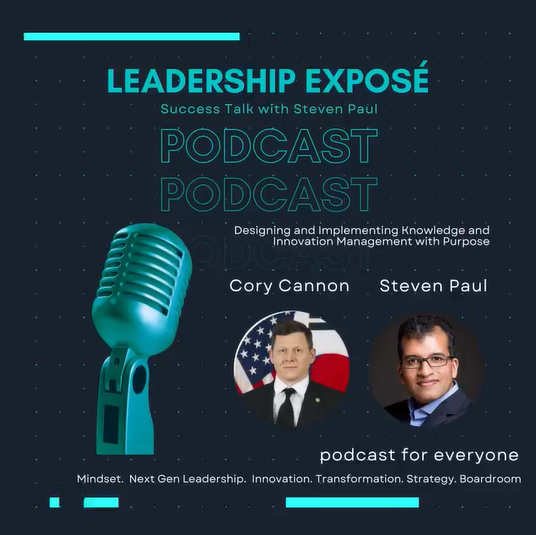
Mr. Cannon was recently on The Leadership Exposé Podcast: Success Talk with Steven Paul |
Episode 42: Cory Cannon: Designing and Implementing Knowledge and Innovation Management with Purpose

In this episode Steven PAUL, CDir FIoD (www.leadershipexpose.com) speaks with Cory Cannon, CKM Cannon, (Major Retired US Army Reserve), working as the Command Knowledge Leader at United Nations Command, Combined Forces Command, and United States Forces Korea (UNC/CFC/USFK) in South Korea. Cory brings diverse leadership experience, and accomplishments within and outside the military.

We will hear about Cory and learn.

✅ How he is leading Knowledge and Innovation Management 
✅ How he unlocks and embeds the pillars of People, Processes, Organizational Culture, and Tools
✅ Leadership intersections and lessons learned and applied in the military and commercial worlds

Tune in:
🎙Spotify: https://lnkd.in/eYsz8jUr
🎙Apple Podcasts: https://lnkd.in/ewEuewbA
🎙Google Podcasts: https://lnkd.in/eqc4F5Hg
🎙Amazon Podcasts: https://lnkd.in/eMt2tduQ
🎥YouTube VIDEO with Captions: https://lnkd.in/euqPUYTE
🌐Leadership Exposé Innovators Page: https://lnkd.in/eHR4t6n5

I have been going some academic research on Knowledge and Innovation Management and how it interlinks to decision-making at a strategic level. Looking at the “DIKW Hiearchy or Pyramid” as presented by Rowley 2007.

Figure 1: The data-information-knowledge-wisdom (DIKW) hierarchy (Rowley 2007, p. 164)

It starts with Data and goes to Information then Knowledge and at the top is Wisdom. Going through this model there are four assumptions that are made:

  1. All data is relevant.
  2. All data can be synthicised into factual information
  3. Information to Knowledge without applying Intelligence or logic to the information
  4. Wisdom can exist without insight or intelligence

So with these assumptions in mind I am proposing a new path from data to wisdom. (Roll over the words for the defintions from Merriam-Webster Dictionary)

  1. Data
  2. Facts
  3. Information
  4. Knowledge
  5. Insight
  6. Wisdom

Below is an infomation graphic that shows a revised path from Data to Wisdom.

Developing a Knowledge Management framework utilzing the above model allows to close the loop in the four assumptions. This would also allow the users of the model to take a closer look at what data and information is being used to develop knowledge and wisdom for any organization.

References:

Rowley, Jennifer E. 2007. “The Wisdom Hierarchy: Representations of the DIKW hierarchy.” Journal of Information Science 33: 163-80. doi.org/10.1177/0165551506070706

My friend Nick Milton from Knoco wrote this the other day on his blog. I think it has some great lessons that can be applied to the military community. ——- Knowledge stores need to determine the various validity levels of the knowledge they contain. Knowledge comes in different levels of trust, and you need to make it clear to the reader what level applies to the documentation they are reading.

There are three main levels:

  1. Mandatory, or “Must Do”. This is the level of company standards, and everybody reading this particular process documentation needs to be very clear that they need to follow exactly what’s written. If there is a major problem, they need to get in touch with the process owner and discuss it with them, but that the default should be to follow this documentation exactly.
  2. Advisory, or “Should Do”. This is the level of best practices, and everybody reading this particular process documentation needs to be clear that this is the best way to approach this particular process, based on current company knowledge. However there is always the possibility to improve on best practice, and if somebody can find an even better way, then that’s great. So Advisory process is advised, but not compulsory. However if people ignore advisory knowledge and things go wrong, some awkward questions may be asked.
  3. Suggested, or “Could Do”. This is the level of good ideas or good practices that others in the organization have used, which the reader should feel free to reuse or re-adapt to his or her own context.

These good ideas can still save the reader a lot of time and effort, but there is no real requirement to copy them. In BP drilling in the late 1990s, corporate process documentation was divided into these three levels of validity, and these were labeled Principles, Processes and Practices. This labeling made it very clear to the reader how much scope they had to vary the process from what was in the documentation. My colleague Tom, in his book Knowledge Management for Operations and Manufacturing, tells about the BP Operations Excellence toolkit, which illustrates this well. The BP Operations Excellence toolkit is structured around the level of validation that has been applied to the knowledge.

At one level there is the highly vetted, approved knowledge in the form of corporate standards and required practices, which are referenced under the heading ‘The BP Way’. At the opposite end of the spectrum is the knowledge in the Question and Response system, eCLIPS, which is totally unvetted. BP went a step further and provided a ‘health guide’ to the advice you were receiving. Captured knowledge is presented in a hierarchy, as follows; •The “BP Way” These tools describe the way BP does business (ie BP policy). This should be the first place to look when identifying ways (the “what” and “how”). •Good Practices These describe good practices identified for the relevant elements by either experience from operating assets or subject matter experts. •Community discussion forum

This section links you to any questions (and responses) that have been asked about the relevant element and allows you to ask the Community if you have been unable to find an answer in the toolkit. All entries are purely voluntary and are not validated by Subject Matter Experts. This hierarchy is very important as it gives the reader a sense of how reliable the knowledge might be. Thus if the advice provided is in the form of The “BP Way” then the reader knows that this is a fully validated and approved policy or procedure and can be followed with confidence. At the bottom end of the scale, advice provided via the community forum, which is not validated, needs to be treated with a lot more caution.

Dr. Franc Calabrese, one of the founders of the International Institute of Knowledge and Innovation (IIKI) at George Washington University as well as a visiting professor at Bangkok University. His passing in 2020 left the KM community with a very large experiance gap that Dr. Calabrese held for many year. I was fortuniate enough to take a couple fo his classes while attending Bangkok University and captured his lesson plans and other documents (to include his thesis) and saved them in my personal knowledge repository.

Dr. Franc Calabrese

This year I was able to share those documents by doing some voulnteer work for the Institute while going thorugh the Knowledge Management Global Network KM AI Course. This idea came to life when Dr. Arthur Murray was telling me his connection to both IIKI and Dr. Calavrese and his desire to do something in Dr. Calaverse’s honor. My initial thought was to share the knowledge and wisdom he imparted on my class years earlier by sharing the documents with others within the community. Dr. Murray and I decided to develop a Knowledge Preservation Library where his thoughts and articles that he was inspired by could live on imparting some of Dr. Calaverse’s wisdom to others. Access to this library is for those who have membership to IIKI but being able to help rekindle some of his thoughts on a variety of topics from AI to Science to Education.

Soon after word got out to a few of the other members of IIKI and they are starting to put in their repositories into the library as well. Dr. Alex Bennet and her husband Dr. David Bennet from Mountain Quest Institute has also contributed their works. This was a great experiance being able to bring life to a new generation of professional knowledge managers.

Earlier in 2021 I presented to US CYBER COMMAND via Teams on why organizations should have a Knowledge Management Strategy. This KM Strategy should be centered on the organization’s mission and vision then branch out to the strategic objectives (3-5 years). The KM Strategy is that roadmap the organization can use to go from a reactionary organization to a learning organization.

Mr. Cannon’s Presentation to US CYBERCOM

I was on LinkedIn and noticed an interesting group called 100 KM Coffees.

I requested to join the group to see what type of digital water cooler it was and was glad I joined.

The creator Rebecca Danicic created the group for KM Professionals and KM job seekers to showcase diverse applications of KM in various contexts, and to be able to share takeaways from her interviews/virtual coffee meetings.

I had the privilege to have a virtual cup of coffee (I actually had the House Blend from The Cannon Bean roastery in an American Press style) with Rebecca and had a great time talking about Knowledge Management and coffee.

Over the course of an hour there were four major questions that Rebecca asked me from our conversation which included:

  • How consultants can embed solutions which would live on after the consultants has left the organization?
  • Does fostering a “learning culture” require a flattening of hierarchy?
  • How can Knowledge Management affect decisions within an organization?
  • How did I get started in the coffee business?

Rebecca posted her outcomes from our conversation on the 100 KM Coffees where I hope you stop buy and take a look around and connect with others within the Knowledge Management community.

This experience with Rebecca reenforces my belief in communities of practice and community of interest. If you are interested in starting up your own community of practice or community of interest within your organization, please feel free to reach out.

There is a belief out there in industry and in the Department of Defense that if I have SharePoint or some other system (KMS or Information Management System) that they are doing Knowledge Management. Or the person that is doing their portal site is the Knowledge Manager for their organization. That may or may not be the case depending on the individual. The tool does not manage the Organizations Knowledge nor should it. The tool manages information within the organization so that the individual who is reading or analyzing the information can use their knowledge to make decisions based on the information provided.

Some businesses out there will try to sell you a KMS (Knowledge Management System) which in reality is either a document repository, a lessons learned repository, a collaboration space, or records management system. I am not saying that these are bad things to have for any organization. Even with infusion of an AI system or chatbot with these systems your are not truly preforming Knowledge Management for the organization. This is information management the 1’s and 0’s are stored and that is only 1/3 of the entire organizational knowledge. 2/3s of any organizational knowledge reside within the minds of the people who work there.

Knowledge Management has four main pillars:

  • People
  • Process
  • Organizational Culture
  • Tools (Digital and Non-Digital)

Each of these pillars are important to any organization and the ROI is actually higher when one focuses on the first three pillars rather than socking funds into a Information Management System.

People

People are the most important part of any organization. Without it why does the organization exist in the first place. Ensuring that you have the right people working for you in the organization that understand the mission and vision and can preform at the position assigned is key to a successful organization. Being able to keep good people who are excited to work will bend over backwards for the organization. That includes giving them opportunities to grow personally and professionally.

Process

An organizations processes can make change management and innovation management difficult to do if every time a change or innovation needs to take place the “red tape” makes it too difficult for change to take place. Reviewing processes, policies, and procedures can improve how the organization is run and the ability for your employees to actually do the work they were hired to accomplish. These processes can also help assist in developing courses of action for the decision-makers to make sound and timely decisions based on the current environment. It can also create white-space in the staff and decision-makers calendars to be able to focus on developing accurate analysis of data and information coming into the organization.

Organizational Culture

Culture is one of the hardest things to change within any organization that is past the Start-up phase of development. When a company is first developing through the seed and start-up phases everything seems to be fast and flowing smoothly then when the organization gets establish that is where culture starts to set in. The need to get out of habits of “we have always done it this way” or “we cannot do that because…” the organization is a living breathing thing that has a vision and mission. Organizations need to embrace change and learning ways to improve their product or services. If you do not some other company who has embraced this mindset will over take your foothold and even poach your employees.

Tools (Digital and Non-Digital)

So tools, you noticed that I placed digital and non-digital tools here. Tools should be only 5-10% of the organizational focus when it comes to Knowledge Management. But I know that most people in any organization see the tool as the football and everyone is running to it. Because that is what everyone can see and interact with on a daily basis. Knowledge Management ≠ Portal or SharePoint. Tools can be a map board, a butcherblock paper on the corner of the conference room, it can be the whiteboard hanging on the wall. It can even be PostIt notes to remind you of that 14:00 appointment with the doctor.

Do not get me wrong, tools are important to store documents, input data, maintain records, and visualize the Key Preforming Indicators for the organization. All of those things are important but they are not the end all be all for your Knowledge Management program.

I had a great time talking Knowledge Management with Aurélien Vasinis, CEO of Brainsfeed. To hear some perspective on pay walls, the academic side of Knowledge Management, and Knowledge Management within the U. S. Department of Defense In this interview, Aurelien and I discuss why this pandemic is the perfect time for Knowledge managers to shine. Grab yourself a cup of coffee and click the link below. I will embed the video on this post soon.

Over this Covid-19 pandemic, I have been looking forward to being able to make those business to business networking connections again and gain more clients. One of the most important thing I have learned from this experience is how Knowledge Management can be done with your family.

The four pillars of Knowledge Management are People, Process, Organizational Culture and Tools. Applying these to your everyday day life can help with a multitude of things from the kids school and activities schedules, bills, doctors appointments, work schedules (yes even when WFH).

The people part of this equation is easy (your family) and each person has a role they play in the family unit. This includes doing the dishes to feeding the animals. Establishing what each person does helps manages what needs to be completed.

Process like it or not is just as important in the business arena as in the home. Processes on how bills are paid, what the approval process is for the kids to be able to get time on their Xbox or electronic devices. Establishing a clear process for your family on how things gets accomplished can help get things done more effectively.

Organizational culture, the family unit is a culture on its own. You have the parental unit(s) as well as the kid(s) and there is a definite cultural dynamic that comes into play on how situations are dealt with on a daily basis.

Tools so how do you keep your family organized, connected and be able to still be able to live. In my home, we utilize Microsoft Office products to include SharePoint and Outlook to keep our documents, bills and other important information where we can collaborate on any decisions that need to be made or have access to our information while we are out in the community. Another tool we use a lot of is whiteboards. I have a Kanban board to monitor my business and we have boards all thought out the house for kids chores, tracking medication, important events and bills. We also take handwritten notes exclusively on Rocketbook notebooks. In terms of our digital meetings we rely on Fireflies to capture audio notes which it does have the capability to transcribe the notes in order to search for information after the fact.

Looking back from the beginning of this pandemic until now, my family and I have gotten closer as well as become better stewards of our Knowledge that each of us has. We are also communicating better as a family.

If you our your company would like to know how Knowledge Management can help improve your business and your bottom dollar. Please feel free to contact me via email at cannonco@cannonco.net or by phone at 620-719-6004.

There are a lot of books and articles on both knowledge transfer and a lot more on how to conduct a productive meetings (“Death by Meeting” is one of my personal favorites).

We have all been there. The weekly meeting with you giving updates to your boss and your boss giving you guidance on what to do. Have you stop to think about the exchange that is going on during that period of time. Probably not for most of us.

Knowledge transfers from tacit to tacit in a meeting and sometimes tacit to explicit (if executive summaries or notes are kept).  With the current environment of working from home and the utilization of digital tools (to include some AI) to assist with decision-making. One must look at the actual contents, and data that is being used that will assist with the decisions as an output of the meeting.

Having been in the military I have seen a lot of successful meetings and a lot more unsuccessful ones. Below are five tips to make a successful meeting:

  1. Only hold meetings that need to be held. Yes it is okay to cancel a meeting.
    • Is there new information to discuss? Are there collaborations that need to take place where a broader audience can provide input? Is the decision made at the meeting going to affect multiple departments within the organization?
    • If just one or two people can solve the issue then it would be more appropriate to do an ad hoc meeting with just those individuals or resolve the issue and allow the rest of the team to go about doing their jobs without “wasting” their time with another meeting.
  2. Have an agenda and stick to it.
    • Having a set agenda will set the tone of the meeting, and gives outcomes and focuses the discussions to the topics.
    • Try not to go down “rabbit holes” of discussions. This waste everyone’s time and in turn will result in lower attendance in meetings in the future. It is a good idea for “brain-storming sessions” to think about possible courses of action as well as possible outcomes. But these types of meetings need to be set apart from a working group or a decision-based type of meeting.
  3. Have a meeting process map established for your organization.
    • This way the entire organization know where to present new ideas or topics and how to get it in front of decision makers.
    • This process map should include, not only the BPMN but the format for the meeting (PowerPoint templates, Word Documents, OneNote, PowerBI, Dashboards, Whiteboards, etc.) as well as the players involved with the process.
  4. Have a charter or “7-Minute Drill” for the meeting and have it as your introduction.
    • The Charter or 7-Minute Drill should have the purpose of the meeting, the location/time, who needs to be in attendance, what information is needed to hold the meeting and where the information/decisions of this meeting go to, where to find the minutes/executive summary for the meeting. A sample 7 Minute Drill is located below.
    • This can be shown at the start of the meeting as a reminder of why the participants of the meeting are there and where they need to focus their conversations.
  5. White space on calendars are important
    •  I have seen some Senior Executives and General Officers block off their white space where they can focus on their job per their job description. Personally, this is a good practice to get into. Blocking off time allows others to see when you need your focus time to do your job.
    • If you follow the first part of this make sure you also have white space on the calendar where you are available to take on meetings or other conversations. If not utilized you can still do your work.

Back at the first of the year, I had a meeting with Benjamin Anyacho, a Knowledge Manager from the Texas Department of Transportation, at a local restaurant in Austin. I mentioned to him that we need to pool our collective resources and start having a conversation with other Knowledge Managers within the Austin and Central Texas area.

With the COVID-19 pandemic and the transition of many of us to work from home, we have been delaying the start of this KM Community. After talking with each other for the past few weeks we decided that it is actually a good time to start up and have conversations and possibly share ways we as a community can get to a place of the new normal.

On June 25th at 11:30 AM until 12:30 PM Central Time (in the US and Canada) will start the Knowledge Management Community of Austin (KMCA) Knowledge Cafe. We want to brainstorm with other Knowledge Managers within the Austin and Central Texas community towards a possible knowledge exchange. Knowledge management practice is increasingly becoming a sine qua non for business success. Several smart cities and regions are organizing themselves around KM practice and community.

Please register in advance for this meeting:
Zoom registration: https://us02web.zoom.us/meeting/register/tZUudOCqqjIoGdEdvRJGVonwU84W5DzAQVu1 After registering, you will receive a confirmation email containing information about joining the meeting.
Information on Eventbrite: https://www.eventbrite.com/e/knowledge-management-community-of-austin-area-tickets-106014347768?ref=esli&utm_campaign=201308&utm_source=LinkedInenivtefor001

Benjamin also created a LinkedIn group for this new community of professionals and is located at the following web site: https://www.linkedin.com/groups/12436066.

Over the past few weeks, a lot of companies across the globe have had to change their views on “telework” or “remote work” policies due to COVID-19, just to stay in business. After all of this, are we going to learn how to transition from the “9-5” work environment of office buildings and cubicles? Are there going to be more “remote work” jobs available in the workforce?

My experience working from home since the COVID-19 “shelter in place” orders started to roll through Texas has been both positive and negative. Here are some of my personal observations over the past month working from home.

[table id=remote_work /]

One of the major things I have learned from this experience is that is what service can I bring to the table to other companies that are going through the same thing. How are they communicating with their employees (Zoom and Microsoft Teams appear to have increased use quite a bit since this has started)? Not only talking to each other about work but the social interaction with each other is another reason why we work. One of my peers just hosted a videoconference about bringing the team together (completely optional) and just talk about whatever is on their mind (school, hobbies, family, etc.). This company truly cares about their employees well being and being able to do this has actually brought the team closer together.

How is business being done now? How are decisions being made (or are they)? Spending over 21 years in the military there were plenty of times where I had to work outside of the “office space” and still was responsible for reporting up to my leaders as well as coordinating my teams.

As an organization you have people and with that, you must plan on how to interact with them to be able to get your mission and vision accomplished in order to have the business survive. Developing a strategic level Knowledge Management plan for your company in a remote work situation. This can answer questions your employees may have when they are forced to work from home.

When developing this plan some things you want to keep in mind are connectivity, access, capabilities, benefits, and expectations.

Connectivity is not only is your business connected but are your employees able to connect to the company’s internal site to work. Access, is your internal portal, collaboration sites, communities of practice available while working from home? What are the capabilities your employees of working remotely (desktop, tablet, mobile, etc.). What benefits is the company willing to offer while working remotely? Finally, what are the expectations (not only from the CEO but the VPs, Division chiefs, Middle Managers, etc.) to ensure the work is being done

During this time of social distancing, quarantine, and working from home. A simple question must be asked. Was your company or business ready to do work outside of the business space? Or did you have to rush to find possible ways to have your workforce able to work from home? Did you have to layoff or fire employees just because your company could not adjust to these times?

There will be some businesses no matter how well they plan for something like this they will have to close up shop (at least temporarily) due to not being an emergency essential type of business. So the next question is what can you do during this time?

One of the many activities I have been doing is some Personal Knowledge Management in terms of how I organize and maintain information on my home system (the same can be done with your organization artifacts as well). I call it my digital spring cleaning. This is where I take a hard look at the artifacts, images, documents, etc. to see what is stuff that I have collected over the past few years. Of course, I retired from the military in February 2019 and I still have pay stubs from 2000 and certificates from 1998.

Some of the information I will keep and put in an archived state (pay stubs, official awards, and recognitions, tax records) and other stuff (bill statements, irrelevant articles, random pdf’s from places I have visited) will be disposed. Other artifacts I will transform what their current media (Word documents, Excel sheets, PowerPoints (if I had a dime for every PowerPoint I made in the military I could retire a very comfortable lifestyle)) and change them to pdf’s or in some cases in custom lists in SharePoint in order to me to track trends on particular information.

One of the other things I have been doing on my own information is developing a naming convention that I can stick with so that I can pile and metatag my artifacts without building out folders in my portal site.

If you have any questions on how to do this on your local portal, page or even hard drive please feel free to contact me at cannonco@cannonco.net

This is a presentation Mr. Cannon gave at the KM Showcase 2020 on how decision-making is done in a strategic command.

“I’m speaking at the upcoming KM Showcase conference in Arlington, VA on March 4-5 and hope to see you there. To register, go to: https://tinyurl.com/uxplmlue #kmshowcase2020 #knowledgemanagement

Mr. Cannon did a second podcast with Mr. Edwin K. Morris of Pioneer Knowledge Services on the topic of Education in Knowledge Management. In this podcast, Mr. Cannon explains his journey in academia to get training in Knowledge Management.

Discover what academics look like in the knowledge management field. Mr. Cannon chats about his experience as a student and teacher.

Mr. Cory Lee Cannon is a Certified Knowledge Manager and is with Cannon-Lear Enterprises and KnocoTexas.

Recorded 5 NOV 2019

Listen to Pioneer Knowledge Services – Because You Need To Know With Guest Cory Cannon 2019 by Edwin K. Morris on #SoundCloud or on #Spotify

https://open.spotify.com/episode/7vYhCmbfvoKNzcZDt12lpP?si=abK_Dpr1Q_ivbupejRb3wQ#_=_

Back in May our President and CEO (Mr. Cory L. Cannon) was asked to do an interview with Edwin K. Morris, President and Founder of Pioneer Knowledge Services. The main topic was Integration of organizational elements create a knowledge culture. Mr. Cannon tells about the inspiration and view his experience brings to KM. The interview SoundCloud or Spotify

https://open.spotify.com/episode/6bi9NnN48IqhFOlCud5a7d
(more…)

A United States,​ Department of Defense perspective on the distinction between Knowledge and Information, and what this means for KM within the DoD. After personally working on the Department of Defense Instruction for Knowledge Management for the past 4 years I am proud to say that we have agreed on a definition for Knowledge Management and the Instruction will soon be published.

The DoD will define Knowledge Management as a discipline focused on integrating people and processes enabled by tools, throughout the information lifecycle, in order to create shared understanding and increase organizational performance and decision-making.
In contrast, the DoD defines information management as the function of managing an organization’s information resources for the handling of data and information acquired by one or many different systems, individuals, and organizations in a way that optimizes access by all who have a share in that data or a right to that information.

Thus within the DoD Information Management is more on how to gather and access the data where Knowledge Management is taking that data and turning it into organizational shared  understanding that can be utilized for decision making.

On 7 November 2017, I had the pleasure to present at KMWorld in Washington D.C. on Knowledge Management in a Combined/Joint Environment. This was based on the research conducted between the years I was in CJTF-OIR and in United States Forces Korea. More information is located on the KMWorld site. Slides are published on the KMWorld Site

One of the many services that Knoco Kansas provides is Communities of Practice Services to organizations these services range from launching a community, gauging the maturity, as well as training and coaching community leaders and facilitators. Communities of Practice are one of the pillars of a solid Knowledge Framework. Many government agencies like the FBI, DoD and NASA have created Communities of Practices ranging from topics as proposed administrative rules and regulation changes to creating entire processes and procedures that are scenario based.

Community of Practice

We help you get your Communities of Practice off to a flying start, through facilitating a one-day or (ideally) two-day launch program. This will be a mixture of introducing the structure and theory of the Community of Practice, and Community of Practice discussions around key topics.

We can check and track the health of your Communities of Practice, through applying a ten-component maturity assessment framework. This Community maturity assessment not only gives you a benchmark to measure development against, but also identified those factors that need the most attention.

We can train your Community leaders and facilitators in the effective operation of Communities of Practice, and how they deliver value to the business, through a combination of theory, case studies, and exercises working on your own Community of Practice issues. 

We can coach your Community leaders and facilitators in building and sustaining their Communities of Practice. Community leadership is a demanding task, and we offer to support the Community Leaders either through regular coaching visits, or through remote coaching through email, teleconferences and Skype.

Below are links to more in depth information on each of these services within Community of Practices please feel free to browse through them if there is any more information you want please feel free to contact me at cory.cannon@knoco.com 

Launching Communities of Practice

Knowledge Management Training Course List

Knowledge Management Coaching

Cory Cannon

Cory Cannon Certified Knowledge Manager Cannon-Lear Enterprises L.L.C.

Hello my name Cory Cannon of Cannon-Lear Enterprises L.L.C., which is an affiliate of Knoco Ltd. Just few bits of information about myself. I have been in the military (between the United States Marine Corps the United States Army and Army Reserves) for 17 years this year and have worked as a Department of Army Civilian at the Center for Army Lessons Learned for 3 years. During that time I have deployed twice to Iraq to conduct logistical convoys, and focus on Knowledge Management activities for the Senior Logistics Command in Iraq.

I received my Certified Knowledge Manager certification through the International Knowledge Management Institute and have taken the Army Knowledge Management Qualification Course to receive the additional skill identifier of Knowledge Management Professional. Academically, I have a bachelor degree in Political Science from Emporia State University a master’s degree in Political Science from Fort Hays State University and currently a PhD student at Bangkok University in the area of Knowledge and Innovation Management.

As a retired Major in the United States Army Reserves, I was the Knowledge Management Officer of a General Officer Command assisting with the Department of Defense and Joint Staff with developing Knowledge Management career path for both military and civilian government employees. I am also a PhD Graduate Assistant at Emporia State University where I supervise the School of Library and Information Management’s technology support desk as well as preform Knowledge Management assessments.

The services I conduct for Knoco Ltd are listed in the graphic below

KM_Wheel-Image

Knoco Ltd. KM Service Wheel

If you would like to have more information on any of these services please feel free to contact me at cory.cannon@knoco.com

Through my years working in Knowledge Management in both the military and civilian realms, one of the items that always comes up is the importance of governance for the program. Establishment of clear expectations for how Knowledge Management program will work in the organization provides that much needed guidance for the Knowledge workers in the company.

There are three simple things to consider when developing these expectations:

Ensure your Knowledge Management policy follows the mission and vision of the organization. Having your governance nested with the mission and vision links your program to the larger strategic goals of the company and gains that crucial buy-in from the Corporate Levels of the company.
Include a statement from the leadership expressing the importance of the program. This can be a simple one page forward or memorandum from the person who is either the company president or the person who acts in the Chief of Staff role for the organization. This statement gives validity to your program and shows the middle management they need to take this policy seriously.
Understand who is your audience: If your company is at one location with only local individuals then KM governance and a KM policy are relatively easy to develop. However, if the organization involves multiple locations and especially different cultures, these have to be kept in consideration.

These considerations, no matter if the organization is only 50 people from the local neighborhood or 50,000 people from 64 nations gives the focus on your program and the importance it is not only to yourself but how it affects the entire mission of the company.

Contact us for help in defining your own KM policy. Or click here for the February edition of the Knoco Ltd Newsletter